
What does your business growth plan for 2027 look like?
Perhaps you’re planning to launch new services, enter new markets, invest in additional marketing channels or increase your marketing activity. You might be considering a new website, implementing AI tools or recruiting more people to support your ambitions.
All of these could be worthwhile investments. But before adding anything to your plans, there’s a question worth asking: What are you going to stop doing?
Most growth plans begin with a list of new initiatives. More customers. More campaigns. More products. More opportunities. Yet every new commitment consumes time, money, attention or capacity. Without making room for those commitments, you risk spreading your resources so thinly that nothing receives the attention it deserves.
The result? A business that’s incredibly busy but isn’t necessarily making meaningful progress.
At our September 80×20 event, we explored why saying no can be one of the most important strategic decisions a business makes.
In this article, we’ll explore why saying no can be one of a business’s most important strategic decisions. We’ll look at four areas where you may need to say no, how to identify what’s genuinely contributing to your success, and how to build a focused, measurable growth plan for 2027.
TL;DR: Your 2027 growth plan
A successful growth strategy isn’t necessarily about doing more. It’s about concentrating your resources on the activities that deliver the greatest value.
- Start with your business objectives before deciding which marketing activities to undertake.
- Identify customers who aren’t commercially or strategically suitable.
- Review low-value products and services that consume resources without contributing enough.
- Stop marketing activities that lack a clear purpose or evidence of effectiveness.
- Resist distracting opportunities that compete with your main growth priorities.
- Use commercial data to make decisions rather than relying on habit or emotional attachment.
- Create a practical plan identifying what to stop, continue and focus on in 2027.
The goal is to create the capacity to do more of what works, rather than to simply do less.
80×20 Recap
Why doing more isn’t always the answer to business growth
Running a business means dealing with a seemingly endless stream of opportunities.
A customer asks whether you can provide an additional service. Your marketing manager suggests launching a new marketing campaign. A competitor starts using a new social media platform. Your team identifies another market you could enter.
Individually, these ideas might sound attractive. The problem arises when you keep saying yes without considering what each commitment means for everything you’re already doing.
Before long, your business is juggling competing priorities.
The competing priorities problem

Every new commitment creates another demand on your resources. And to accommodate every new demand, space needs to be created. Above is the Martech Technology Landscape, showing the available technologies, highlighting how limited your time could be if you allocated time to a fraction of them.
In a business where you have limited time, money, attention and capacity, not creating space can lead to:
- Inconsistent execution
- Diluted budgets
- Unfinished projects
- Overwhelmed teams
- Unclear results
To highlight the problem, at one time or another, Xpand has been guilty of all of these over the years and in a small business, it continues to be something we have to manage.
The hidden cost of every new commitment
Every time you say yes to something, you’re making a trade-off, whether that’s time, money, attention or capacity. The real cost is the more valuable activity it stops you from doing.
Agreeing to develop a new service might mean postponing improvements to your most profitable offering.
Investing in another marketing platform could divert budget from a channel that’s already generating valuable enquiries.
Accepting an unsuitable customer might prevent your team from taking on work from a more profitable one.
Economists call this opportunity cost: the value of the next-best alternative you give up when making a decision. It’s particularly important for SMEs, where resources are often limited, and the same people are responsible for multiple areas of the business.
Constant interruptions make effective execution harder
There’s also the issue of attention. A controlled study by Altmann, Trafton and Hambrick found that interruptions lasting approximately 2.8 seconds doubled sequencing errors during the task being studied.
Research discussed by Professor Gloria Mark has also highlighted how frequently people shift their attention between screens, reporting an average screen-attention duration of around 47 seconds in the environments examined.
These studies aren’t direct measurements of business growth or marketing effectiveness. However, they illustrate the challenges associated with interruptions and fragmented attention.
When your team is constantly switching between projects, responding to new requests and changing priorities, maintaining concentration and consistent execution can become more difficult. Research has shown that juggling multiple projects is also detrimental to meeting deadlines.
And this is where the symptoms start to appear.
Five warning signs that your business has too many priorities

Inconsistent execution
Campaigns are launched enthusiastically but aren’t maintained. Projects repeatedly lose momentum as new initiatives take priority.
Unfinished ideas
Your business has a growing collection of half-completed projects, each consuming resources without delivering its intended benefits.
Overwhelmed teams
Employees are juggling multiple responsibilities, deadlines are slipping, and there’s little capacity to deal with unexpected problems.
Unclear results
Your business is producing plenty of marketing activity, but it’s difficult to establish what’s actually contributing to commercial performance.
Diluted budgets
Investment is distributed across so many activities that individual initiatives may not receive enough resources to be executed effectively.
If several of these symptoms sound familiar, your business might not need more ideas. It might need fewer priorities.
Start with the result, not the marketing activity
One of the most common mistakes businesses make when developing a growth strategy is starting with the activity.
“We need to post more on LinkedIn.”
“We should invest in Google Ads.”
“We need a new website.”
“We should start producing videos.”
These are tactics, not business objectives. Before deciding what marketing activity to undertake, you need to establish what you’re trying to achieve.
At Xpand, we encourage businesses to work backwards from the result they want.
The results-first approach
- What must the business achieve? Establish a clear, measurable commercial objective.
- Who is the audience we want to reach? Identify the customers who can help you achieve that objective.
- What needs to change for that audience? Understand what must happen for those customers to become aware of, consider and ultimately choose your business.
Only then decide which marketing activity is needed.
Let’s look at an example.
Imagine an accountancy practice wants to acquire 12 additional business clients in 2027. Its existing data shows that approximately 25% of qualified enquiries become customers.
To acquire 12 clients, it would therefore need around 48 qualified enquiries, assuming that conversion rate remains consistent. That’s four new qualified enquiries per month.
Now the practice has a measurable objective.
It can investigate where its existing customers come from, which services generate the most profitable work and how potential clients research accountancy firms.
Perhaps its strongest opportunities come from organic search and professional referrals. If so, investing in SEO, improving service pages and developing referral relationships may make more sense than launching several new social media channels.
The important point is that the decision is based on the commercial objective rather than the latest marketing trend. Your marketing strategy should support your business growth plan, not become an unrelated collection of activities.
Four things your business may need to say no to in 2027
So, what should you consider removing from your growth plan? We’ve identified four areas where businesses frequently accumulate commitments that no longer serve their objectives.
Say no to the wrong customers

It might sound counterintuitive to suggest turning down customers when you’re trying to grow a business.
After all, more customers should mean more revenue. But revenue and valuable revenue aren’t always the same thing.
Some customers generate significant sales while consuming disproportionate amounts of time and resources. Others require services that fall outside your expertise, create operational difficulties or distract your business from its ideal market.
The question isn’t simply whether a customer generates revenue; it’s whether the relationship contributes positively to your business.
Identify customers who drain your capacity
Consider two hypothetical customers.
Customer A generates £30,000 in annual revenue but requires extensive support, frequent revisions, additional administration and significant senior management involvement.
Customer B generates £20,000 in annual revenue, has clearly defined requirements, pays promptly and can be serviced efficiently.
Without examining the costs associated with each relationship, you cannot determine which is more profitable.
Customer A might still be commercially valuable. But revenue alone doesn’t provide the answer.
Review your customers against factors such as:
- Gross profit and the cost of delivering the work.
- Time spent on account management and support.
- Payment terms and payment behaviour.
- Repeat business and customer lifetime value.
- Opportunities for additional profitable work.
- Alignment with your expertise and strategic objectives.
This will help you distinguish between customers who contribute to growth and those who consume resources without generating sufficient value.
Pre-qualify potential customers
Pre-qualifying your enquiries to ensure a good fit is crucial to avoiding the wrong customers. At Xpand, we qualify a customer based on the following questions:
- Does the client respect us and our processes?
- Can we do the work to an excellent standard? Is it within our skillset?
- Will the work be profitable?
- Will we enjoy it?
You can create your own prequalification criteria, but having these questions in mind as you speak to the prospect for the first time will allow you to easily turn potential customers away who are wrong for you.
Opportunities accepted because revenue is available
Accepting jobs just because they provide revenue is a recipe for disaster, and one that we have experienced previously. It’s a common thing for businesses, especially when they are small or starting.
This can lead to working with customers that you wouldn’t ordinarily want to work with.
We once had an enquiry from a potential customer, at a time when Xpand was going through a difficult period, where it would have been easy to take the money (and the pain) and do the work.
But they had broken our first pre-qualification rule. When we presented the proposal to the potential client, we were told it was wrong, that he knew better and that we should redo the proposal. We politely told him that we weren’t the agency for him.
Stop accepting work that takes you away from your ideal audience
Xpand specialises in providing marketing for Professional Services, Construction & Manufacturing clients.
When an opportunity to build an e-commerce website for a B2C client arose, we took it on. The project looked interesting on paper; we were confident we could do a good job, and it would generate attractive short-term revenue.
In reality, the project was beset with problems (not all of our own making), and it overran on both budget and deadline, causing knock-on effects for other areas of the business. We had taken on more than we could chew. The project was ultimately delivered, and the client was happy, but it was delivered at a major loss and with a major headache.
Accepting work outside our specialism took us away from the work we’re good at. Continuously accepting work outside that specialism can make it harder to maintain a clear market position.
How to identify your most valuable customers
Start by reviewing your existing customer base. Identify which customers generate the greatest contribution to profit, remain with you longest and are best suited to your capabilities.
Look for common characteristics. Are they concentrated in particular industries? Do they purchase specific services? Are they a certain size? Do they share similar problems or buying behaviours?
Use these findings to develop or refine your ideal customer profile. Your marketing can then concentrate on attracting more of the customers you want rather than generating enquiries from everyone.
Think of it as becoming more selective about the work you pursue, rather than turning work away indiscriminately.
Where existing relationships are commercially challenging, consider whether repricing, clearer scopes of work or improved delivery processes could resolve the problem before deciding to end them.
2. Say no to low-value products and services
How many products or services does your business offer today compared with five years ago? For many businesses, the list has grown.
Perhaps a customer requested something new. A competitor introduced a service that seemed worth copying. Or an opportunity emerged that was too attractive to ignore.
Over time, these additions become part of the business. But how often do you review whether they still deserve to be there?
Identify services that require significant effort but generate little profit
A service can be popular without being particularly profitable. It might generate plenty of enquiries and consistent revenue, but require specialist staff, expensive equipment, extensive administration or ongoing support.
When these costs are considered, the commercial return may be disappointing, and even promoting such a service may be actively damaging your business.
A good example is from a previous 80×20 event. 888 Safety Solutions provided training and received a lot of enquiries for this, but it wasn’t what he wanted to be known for; it was time-consuming and created capacity issues. Increasing training sales would place pressure on the business without a corresponding improvement in profit. The service wasn’t dropped entirely, but it became a smaller supplementary service alongside his core offering.
If your business offers services or products that go away from your core offering, or they have high delivery costs or low profit margins, it may be beneficial to review these.
The important thing is to make the decision using evidence. Review the revenue, direct costs, contribution to profit and operational demands of each service.
Also consider whether it acts as an entry point to more profitable work. A relatively low-margin introductory service may still be valuable if it consistently leads to profitable long-term customer relationships.
You may decide that the answer is to increase prices, improve delivery efficiency or redesign the offering, or you may decide to drop it entirely.
Remove offers that confuse your market
Another issue arises when businesses try to offer too many different things.
Now, a broad service offering isn’t inherently wrong, particularly when the services are complementary. However, an unfocused collection of offerings can make your positioning harder to communicate.
Potential customers need to understand what you do, who you help and why they should choose you. If your services appear unrelated or your messaging tries to appeal to everyone, that distinction can become less clear.
Review whether your products and services support a coherent market position.
Could certain offerings be grouped together more effectively? Would clearer service categories help? Are some services better suited to a separate brand?
In some cases, simplifying the offering may be more valuable than adding another service.
One example we have worked on was more about the business name confusing the market. The client was a company called Simply Ponds. You may be forgiven for thinking that they worked with ponds. They had originally provided linings for residential ponds, but the business had evolved. The brand hadn’t. The business now provides ground gas protection and structural waterproofing services for infrastructure projects. After conducting a strategy, we recommended rebranding the company as Fend, which has been well received within the industry.
Challenge legacy services
One of the most revealing questions you can ask about an existing product or service is, “If we weren’t offering this today, would we choose to launch it?”
Businesses frequently retain services because they’ve always provided them. But markets change. Customer needs evolve. Technology develops. Delivery costs increase.
A service that made commercial sense five years ago may no longer justify the resources it consumes. Review your portfolio and consider four possible decisions.
| Decision | When to consider it |
| Retain | The service is profitable, relevant and supports your strategic objectives. |
| Improve | Demand exists, but pricing, delivery or efficiency needs attention. |
| Reposition | The offering has value, but customers don’t understand it clearly. |
| Retire | Demand, profitability, and strategic relevance no longer justify the investment. |
Don’t remove services simply because they’re small or generate less revenue than others. Consider their overall contribution, including cross-selling, customer retention and future growth potential.
The aim is to develop a portfolio that supports your business rather than maintaining an ever-growing list of services out of habit.
3. Say no to ineffective marketing activity

As we’ve discussed previously, marketing is an area where it’s particularly easy to confuse activity with progress.
A business might publish five LinkedIn posts a week, send monthly email newsletters, run Google Ads, produce blogs, attend networking events and invest in SEO.
On paper, that looks like a busy marketing operation. But what is it achieving?
How many qualified enquiries are being generated? How many become customers? Which activities contribute to profitable sales?
If you can’t answer these questions, it may be time to reconsider where your marketing resources are going. Busy marketing can still be ineffective marketing.
Stop using marketing channels without a clear reason
One of the most common marketing mistakes is selecting channels because they’re popular or because competitors are using them.
Before investing, ask:
- Who are we trying to reach?
- Does this channel provide access to that audience?
- What role will it play in the buying journey?
- What do we expect it to achieve?
- How much investment will it require?
- How will we evaluate its performance?
Every marketing channel should have a defined purpose.
For example, SEO might be responsible for generating enquiries from people actively searching for your services.
LinkedIn might help build awareness and credibility among a specific professional audience.
Email marketing might nurture existing prospects and encourage repeat business.
These activities can work together, but each needs a reason to exist.
The example we see the most is clients running Google Ads. One particular client was spending £500 per month on Google Ads. We advised them to switch it off before we began working on their marketing strategy. Switching it off made no difference to their enquiries; in fact, it not only saved the ad spend, but it also saved their team time from dealing with poor-quality enquiries for unrelated services.
Stop repeating campaigns without reviewing their results
Consistency is frequently presented as the secret to successful marketing. We’re told to post regularly, publish blogs consistently and maintain a constant presence. Consistency can be valuable, but it only helps when you’re consistently doing something useful.
One particular client was paying a provider to create content for their social media channels, but what they were creating was AI-generated slop. The only people engaging with the content worked for the provider.
Once we conducted a marketing strategy and identified the content pillars that would resonate with their audience, engagement picked up.
It is important to regularly review whether the posts are reaching the right audience, generating meaningful engagement or contributing to the business’s objectives.
This is a perfect example of why marketing needs regular evaluation.
Measure what matters
Different marketing activities require different success measures.
| Marketing activity | Useful measures |
| SEO | Relevant search visibility, organic enquiries, qualified leads and conversions. |
| PPC | Cost per qualified lead, customer acquisition cost, conversion rate and revenue. |
| Social media | Relevant audience reach, engagement quality, enquiries and pipeline contribution. |
| Email marketing | Clicks, enquiries, conversions, retention and revenue where measurable. |
| Content marketing | Relevant visibility, engagement, assisted conversions and qualified enquiries. |
| Brand awareness | Brand search trends, relevant reach, direct demand and audience research. |
Not every marketing activity will generate an immediate sale. For businesses with long buying cycles, brand awareness and relationship-building can contribute to commercial results months before an enquiry arrives.
That’s why it’s important to consider both short-term performance and longer-term contribution. However, you should still be able to explain what each activity is intended to achieve and identify appropriate evidence of progress.
Stop spreading your marketing budget too thinly
Let’s say your business has £2,000 per month to invest in marketing. You decide to divide it equally between SEO, Google Ads, LinkedIn advertising, social media management and email marketing.
Each activity receives £400. Is that enough to execute every channel properly?
Possibly, depending on the circumstances. But it may be insufficient for the work required, particularly in competitive markets, or where competitors have a head start.
SEO, for example, can involve technical improvements, content development, website optimisation, internal linking, ongoing digital PR and performance analysis.
A limited budget may support a tightly defined SEO project, but it is unlikely to cover every aspect of an extensive strategy.
The same applies to paid advertising.
A small budget spread across multiple audiences and campaigns may provide insufficient data or reach to make meaningful decisions.
Rather than dividing your budget equally between channels, consider which activities offer the strongest opportunity to support your objectives.
You may achieve more by concentrating resources on a smaller number of well-executed initiatives.
Conduct a marketing effectiveness audit
Before setting your marketing budget for 2027, review what you’re already doing.
Your marketing effectiveness audit
Use this process to evaluate existing marketing commitments.
- List your activities: Include every marketing channel, campaign, subscription, agency arrangement and recurring activity.
- Calculate the true investment: Consider external costs, advertising spend and internal time.
- Define the objective: Establish what each activity is supposed to achieve.
- Review the evidence: Examine performance over a suitable period (for example, three, six or 12 months versus the previous period, or year-on-year comparison), including qualified leads, conversions, pipeline and revenue where available.
- Identify opportunities to improve: Determine whether disappointing results are caused by the channel itself or problems with execution, targeting, messaging or conversion.
- Make a decision: Stop, improve, continue or increase investment based on the evidence.
Remember that poor results don’t automatically mean a marketing channel is unsuitable. For example, Google Ads might generate plenty of relevant visitors but few enquiries because the landing page is ineffective.
Stopping the advertising without investigating the conversion problem could mean abandoning a valuable opportunity. It is important to understand what’s working, what’s not and why before making a decision.
4. Say no to distracting opportunities

New opportunities can be exciting, offering a change from the norm. Examples may include the launch of a new marketing platform, a potential partner offering a collaboration, or a new market opening up that offers significant growth potential.
These opportunities deserve consideration, but they shouldn’t automatically become priorities. Sometimes, a perfectly good opportunity is simply the wrong opportunity right now.
Don’t chase every new marketing trend
Remember Clubhouse?
The audio-based social platform attracted considerable attention when it launched. Businesses and marketers explored how it might provide a new way to reach audiences and build relationships.
For some, experimenting with the platform made sense. For others, it became another commitment competing for limited marketing resources.
Xpand made the decision not to become an early adopter of Clubhouse, and that decision saved many hours that we could put into other initiatives, as it came and went so quickly.
Businesses shouldn’t avoid new platforms, but it’s important to remember that popularity or hype alone is not a sufficient reason to invest. It has to make strategic sense for your business.
The same principle applies to AI tools. AI can help businesses improve efficiency, analyse information, develop content and automate processes.
But adopting a tool simply because it’s new doesn’t guarantee a commercial benefit. Before investing, establish what problem it will solve, what resources implementation requires and how you’ll measure the outcome.
Recognise when the timing is wrong
Imagine a manufacturing company considering expansion into a new international market. Research suggests demand exists, and management believes its products could be competitive.
However, the business is already struggling with production capacity and inconsistent delivery times. Expanding immediately could increase pressure on operations and damage customer relationships.
The opportunity may be attractive, but the timing is questionable. Improving production efficiency and delivery performance might need to come first.
Saying no doesn’t always mean abandoning an idea permanently. It might just require postponement until the business is ready to capitalise fully.
Another example of wrong timing is during the pandemic. Zoom became the go-to platform for video meetings, a position it has held since. But pre-pandemic, Skype was the market leader. They were there well before the demand, but once the demand came, they were unable to capitalise, eventually being retired in 2025. Microsoft’s own decision to invest in Teams as a competitor to Slack took resources away from Skype, likely contributing to losing its position.
Avoid projects that compete with your main growth goal
Every significant project requires resources. If your primary objective is to increase profitable revenue from existing customers, launching an unrelated product line may compete with that goal.
If you’re trying to improve operational efficiency, introducing several new systems simultaneously could create unnecessary complexity.
An example from Xpand’s past is when we decided to build our own version of Basecamp during a spell of downtime for our developers. Ultimately, the project was never completed, never went live, was a waste of resources, and it would have consumed future resources in maintaining the product.
If you have a lot of projects or ideas, a useful solution is to maintain a strategic car park, where you can ‘park’ ideas and opportunities until you can capitalise on them.
Record ideas that have potential but aren’t immediate priorities. Include their expected benefits, resource requirements and any conditions that would justify revisiting them.
Review the list during quarterly planning. This allows you to remain open to innovation without letting every new idea disrupt your existing strategy.
Use evidence, not attachment, to make your growth decisions
Identifying what to stop can be difficult. Business owners become attached to the services they’ve developed, customers they’ve worked with for years and marketing campaigns they’ve invested in.
But past investment doesn’t automatically justify future investment. Money or resources that have already been spent cannot be recovered. Imagine investing £15,000 in developing a new service.
Six months later, demand is significantly lower than expected, delivery is expensive, and the service is distracting your team from more profitable work.
You might be tempted to continue investing because you’ve already spent £15,000. But that money has gone.
The relevant question is whether further investment is justified by the service’s future potential.
This doesn’t mean abandoning projects whenever they encounter difficulties. It means evaluating their prospects objectively rather than continuing solely because of what’s already been spent.
Before deciding what deserves investment, review six areas of your business.
Enquiries
Where are your enquiries coming from?
Which sources generate the greatest volume, and which attract customers who are genuinely suitable for your business?
A channel generating 100 enquiries isn’t necessarily more valuable than one generating 20 if most of those enquiries are unsuitable.
Review enquiry volume alongside quality.
Sales
Which customers, products and services generate the most revenue?
Look at repeat purchases, average order value, customer retention and opportunities for additional sales.
Identify the areas contributing most meaningfully to your commercial performance.
Profitability
Revenue doesn’t tell the whole story.
Examine the profitability of individual services, customer groups and projects.
Account for the costs associated with delivery and consider whether particular activities consume disproportionate operational resources.
Where possible, evaluate customer lifetime value and contribution to profit.
Conversion rates
How effectively does your business turn opportunities into customers?
Examine the stages between initial enquiry and completed sale.
If you’re generating plenty of qualified enquiries but converting very few, the problem might lie in your sales process, response times, pricing or proposition.
Increasing marketing expenditure may not be the most effective solution until those issues are addressed.
Capacity
How much additional work can your business realistically handle?
Review employee workloads, operational bottlenecks and the resources required to deliver your services.
Growth that exceeds your capacity can create delivery problems and damage customer relationships.
Understand your constraints before committing to additional demand.
Marketing results
Finally, examine which marketing activities contribute to your commercial objectives.
Look beyond traffic, impressions and engagement.
Where the data allows, connect marketing activity to qualified leads, sales opportunities, customer acquisition and revenue.
Consider the limitations of attribution, particularly where customers interact with several channels before making an enquiry.
The aim is to build a sufficiently clear picture to make informed investment decisions.
Identify what’s actually preventing your business from growing
Once you’ve completed your review, you should have a better understanding of the constraints affecting your business.
This is an important step because different problems require different solutions.
Find your growth constraint
Here is an illustrative example of how different constraints change your priorities.
- Not enough qualified enquiries: Review targeting, market demand, search visibility and lead generation.
- Plenty of enquiries, but few sales: Investigate qualification, response times, sales processes and conversion.
- Strong sales, but disappointing profit: Review pricing, service costs, customer profitability and efficiency.
- More demand than you can fulfil: Prioritise operational capacity, delivery processes and resource planning.
- Customers leave too quickly: Investigate customer experience, retention and ongoing value.
If your business has plenty of demand but struggles to fulfil orders, investing heavily in additional lead generation could make the situation worse.
You might achieve a better commercial outcome by improving delivery capacity first.
Equally, if your sales team converts only a small proportion of qualified enquiries, improving conversion may offer an opportunity to grow revenue without substantially increasing marketing expenditure.
Your growth strategy should address the constraint that’s holding your business back, rather than automatically increasing activity across every department.
Five questions to ask before saying yes
We’ve established why saying no matters, but how do you decide which opportunities deserve a yes?
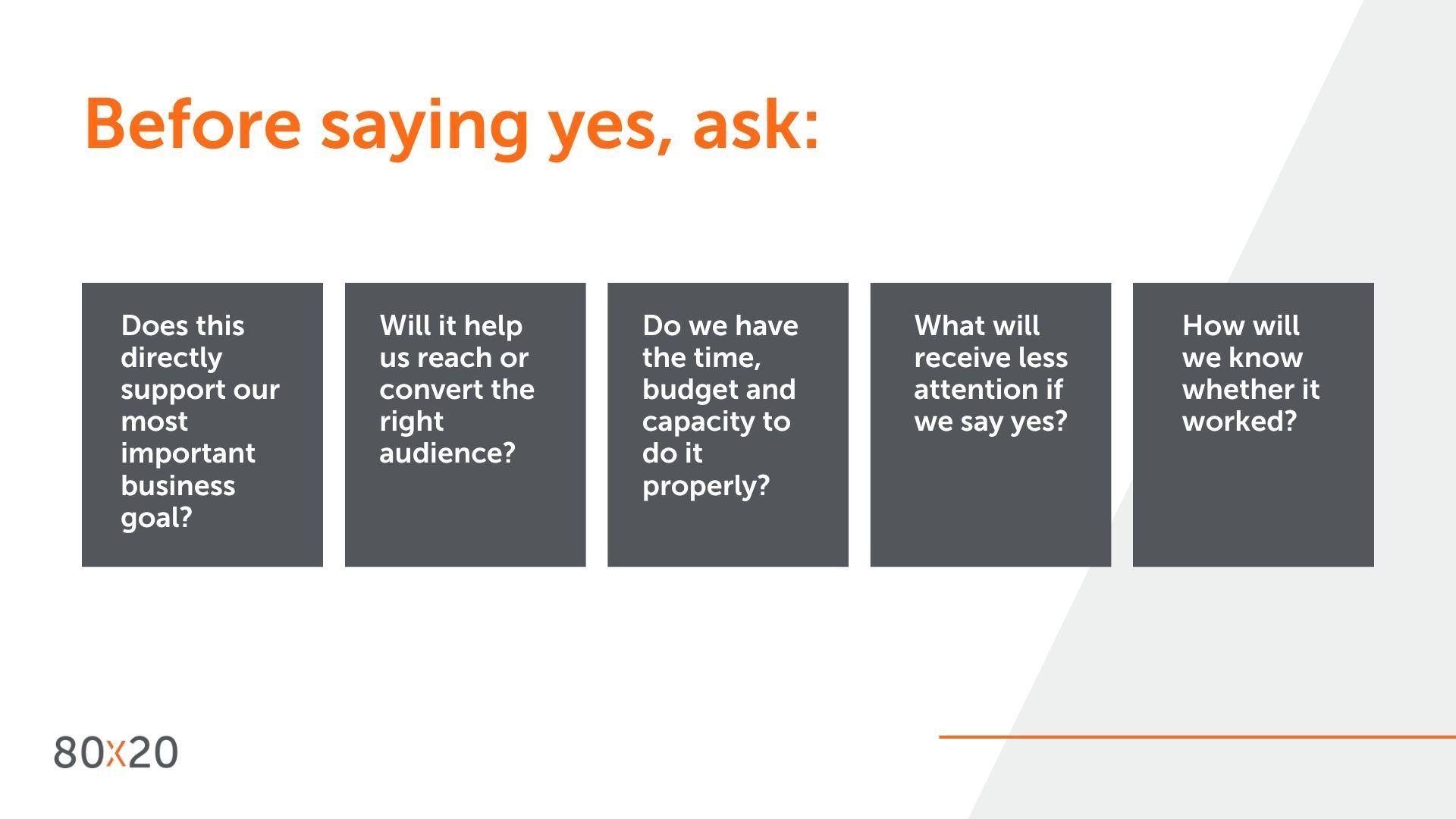
We’ve introduced a simple decision filter built around five questions.
Use it whenever you’re considering a new customer, product, service, marketing campaign or significant investment.
The decision filter
Five questions to help you evaluate new commitments.
1. Does this directly support our most important business goal?
Establish how the opportunity contributes to the commercial result you’re trying to achieve.
2. Will it help us reach or convert the right audience?
Consider whether it attracts suitable customers or helps existing prospects move towards a purchase.
3. Do we have the time, budget and capacity to do it properly?
Evaluate the complete resources required for implementation and ongoing delivery.
4. What will receive less attention if we say yes?
Identify the opportunity cost. Which existing priority will lose resources?
5. How will we know whether it worked?
Agree on success measures, review dates and criteria for continuing or stopping.
The decision filter doesn’t automatically tell the business to reject the idea; it helps ensure the decision is deliberate and commercially informed.
If the answers are uncertain, further research or a limited pilot might be appropriate.
If the opportunity doesn’t support the main objective, requires resources the business doesn’t have and lacks a credible way of demonstrating value, it may be better to defer it.
Create your stop, continue and focus plan
By now, you should have a clearer understanding of where your business may be wasting resources and where the greatest opportunities lie.
The next step is turning those insights into action. You don’t need to overhaul your entire business overnight. Start with three decisions.
Your growth planning exercise
Identify one action in each category:
One thing to stop doing
Identify an activity, customer type, service or commitment that isn’t delivering sufficient value.
Example: Stop investing in a marketing channel that consistently attracts unsuitable enquiries.
One proven activity to continue
Identify something that is already contributing to your objectives and deserves ongoing support.
Example: Continue producing search-focused content that generates qualified enquiries from your ideal customers.
One priority to give greater attention in 2027
Choose an opportunity that directly supports your most important business goal.
Example: Improve website conversion rates to generate more enquiries from existing traffic.
These decisions should be specific.
“Improve marketing” isn’t a particularly useful priority.
“Increase qualified enquiries from our commercial refrigeration installation service by 20% over the next 12 months” provides a clearer direction.
Once you’ve identified your priorities, give each one an accountable owner, a measurable target, an appropriate budget and a review date.
What should you do with the resources you free up?
Stopping an ineffective activity doesn’t automatically generate growth. You need to decide what happens to the time, money and capacity you’ve released.
Imagine your business spends £1,500 per month across three marketing channels.
Following a review, you discover that one channel has consistently failed to reach your intended audience despite reasonable attempts to improve performance.
You decide to discontinue it, freeing up £500 per month. Rather than immediately spending that money on another new platform, you investigate where it could have the greatest impact.
Perhaps your website already attracts plenty of relevant visitors, but the conversion rate is disappointing. Investing the £500 in improving landing pages, strengthening calls to action and simplifying enquiry forms could be worth testing.
Alternatively, you might allocate the budget to a proven channel that’s currently constrained by insufficient investment.
The right decision depends on your business’s circumstances, but you should deliberately redirect resources freed from low-value activity toward higher-priority objectives.
Give your strategy a regular review
Your growth plan shouldn’t be a document you create in December and forget by February. Schedule regular reviews to evaluate progress.
A quarterly strategic review is a useful starting point for many businesses, supported by more frequent monitoring of key performance indicators.
During each review, ask:
- Are we progressing towards our main business objective?
- Which activities are delivering the expected results?
- Have our customers’ needs or market conditions changed?
- Are we encountering new capacity constraints?
- Is there anything we should stop, improve or prioritise differently?
Avoid constantly changing direction before initiatives have had sufficient time to produce meaningful results. The purpose of reviewing your strategy is to maintain focus while remaining responsive to evidence.
How to say no without damaging relationships or missing opportunities
Knowing what to stop is one thing. Actually saying no can be more difficult. Business owners understandably worry about disappointing customers, missing revenue or losing opportunities to competitors.
But declining an unsuitable opportunity doesn’t have to mean damaging a relationship. If a prospective customer requests a service outside your expertise, you could explain your specialism and recommend another provider.
If an existing customer requires work that is no longer commercially viable, you could discuss revised pricing, a more appropriate scope or alternative arrangements.
If a new partnership opportunity is attractive but poorly timed, you could explain that your business is concentrating on existing priorities and agree to revisit the discussion later.
The important thing is to be clear, professional and consistent. Your ideal customers should understand what you specialise in and why that expertise benefits them.
In many cases, a clear position makes it easier for people to understand whether your business is the right choice.
Five mistakes to avoid when simplifying your growth strategy
Saying no is a useful strategic discipline, but it shouldn’t become an excuse for indiscriminate cost-cutting.
There are several mistakes worth avoiding.
Cutting everything that doesn’t generate immediate revenue
Brand awareness, content marketing and relationship-building can take time to influence purchasing decisions.
Xpand first met one of our clients 10 years before they came to us for a new website and subsequent strategy work.
Evaluate these activities against appropriate objectives and realistic timeframes rather than expecting every investment to generate immediate sales.
Removing services based on revenue alone
A smaller service might generate valuable introductions, support customer retention or lead to more profitable work.
Consider its wider commercial contribution before discontinuing it.
Abandoning marketing campaigns prematurely
Some campaigns need time to gather sufficient data, particularly in markets with long buying cycles.
Set clear evaluation periods and investigate performance problems before deciding to stop.
Rejecting every new idea
Innovation remains important.
The objective isn’t to avoid experimentation but to control it.
You could allocate a defined proportion of your budget or capacity to testing new opportunities without disrupting your core strategy.
Cutting activity without reallocating resources
Removing ineffective commitments is only the first step.
The greatest benefit comes when the resources you’ve freed up are redirected towards activities that support your most important objectives.
Frequently asked questions about business growth planning
How do you create a business growth plan?
Start by reviewing your current business performance and identifying your most important commercial objective. Define the customers you want to attract and what needs to change for them to choose your business.
Review existing customers, products, services and marketing activities to identify which commitments support that objective. Then establish a manageable set of priorities with measurable targets, allocated resources, accountable owners and regular review dates.
Why is saying no important for business growth?
Every commitment consumes resources. By declining opportunities that don’t support your objectives, you can release time, money and capacity for activities that may deliver greater commercial value.
Saying no also helps prevent competing priorities from undermining execution.
How do you decide which marketing activities to stop?
Review each activity’s purpose, cost, target audience and performance. Consider its contribution to awareness, qualified demand, sales opportunities and revenue, depending on its intended role.
Investigate whether disappointing results are caused by poor execution or an unsuitable channel. Then decide whether to stop, improve, continue or increase investment.
Should a business stop offering unprofitable services?
Not automatically.
First consider whether pricing, delivery efficiency or positioning can be improved. Evaluate whether the service supports customer acquisition, retention or other profitable offerings.
If it consistently consumes resources without sufficient commercial or strategic benefit, discontinuing it may be appropriate.
How many priorities should a business growth plan have?
There’s no universal number.
The appropriate number depends on your business’s size, resources and the complexity of each initiative. However, your priorities should be manageable enough to receive sufficient attention and investment.
If everything is a priority, it becomes difficult to determine where resources should be concentrated.
How often should you review your business growth strategy?
A quarterly strategic review is a useful starting point for many businesses. Individual marketing campaigns and operational activities may require more frequent monitoring.
Review performance against your objectives, assess changes in market conditions and reconsider priorities where the evidence justifies doing so.
Your growth plan starts with a decision, not a to-do list
As you begin planning for 2027, it’s tempting to focus on everything your business could do.
New customers, new services, new markets, new marketing channels, but adding more activity to an already stretched business doesn’t guarantee better results.
Before committing to new initiatives, examine what’s already consuming your resources.
Are you pursuing the right customers? Are your products and services commercially worthwhile? Is your marketing contributing to meaningful business outcomes? Are new opportunities supporting your strategy or distracting you from it?
Use evidence to make these decisions rather than relying on habit or attachment. Then identify three things:
One thing to stop. One proven activity to continue. One priority to give greater focus to.
A successful growth plan is stronger when you decide what doesn’t belong in it.
Is your marketing working hard enough for your business?
If your marketing is spread across too many activities, or you’re unsure which channels are contributing to growth, it may be time to reassess your strategy.
At Xpand, our SOLAR 7 system helps businesses establish clear objectives, identify the right opportunities and develop focused marketing strategies designed to deliver measurable results.
We’ll help you understand what’s working, what’s holding you back and where your marketing resources should be concentrated.
Ready to make your 2027 growth plan count? Book a one-hour focus session.

