
Ever wonder why some marketing campaigns resonate deeply with certain people while falling flat with others? It’s not just about age, gender, or income; it’s about how people are wired.
That’s where DiSC profiling comes in.
Originally developed as a tool to understand human behaviour, the DiSC model breaks personalities into four distinct types: Dominance, Influence, Steadiness, and Conscientiousness. Each type processes information, makes decisions, and responds to messages in very different ways.
For marketers, understanding DiSC isn’t just a “nice to know”; it’s a strategic advantage. By tailoring your messaging, visuals, and offers to match your audience’s behavioural style, you can boost engagement, strengthen connections, build trust faster, and dramatically improve conversion rates through targeted messages.
In this blog, we’ll break down what DiSC profiling is, how it works, and most importantly, how you can use it to craft marketing that speaks to each personality type. Whether you’re creating ads, writing email campaigns, or developing your brand voice, DiSC gives you the insights to communicate effectively with your audience.
TLDR: The power of DiSC in marketing
Video
Slides
Connect with Jag on LinkedIn and message him to receive a link to a free DiSC assessment.
Understanding your audience goes beyond demographics; it’s about behavioural insight. The DiSC model breaks people into four key personality types:
- D – Dominance: Results-driven, fast-moving, assertive.
- I – Influence: Social, enthusiastic, connection-focused.
- S – Steadiness: Loyal, calm, prefers stability and trust.
- C – Conscientiousness: Analytical, detail-oriented, data-driven.
Each type makes decisions differently, and your marketing should reflect that. Here’s how:
- D-types want speed, outcomes, and authority.
- I-types crave excitement, visuals, and community.
- S-types need reassurance, warmth, and low-risk steps.
- C-types look for logic, data, and full transparency.
Apply DiSC to your marketing by tailoring:
- Messaging (tone, language, CTA styles)
- Content structure (headlines for D/I, depth for S/C)
- Funnels & UX (fast-track for D, nurturing for S, interactivity for I, detail for C)
By speaking your audience’s behavioural language, you don’t just market better, you convert better.
More trust. More engagement. More results.
What is DiSC?
DiSC profiling is a behavioural assessment tool based on a theory developed by psychologist William Moulton Marston and is used to understand how people behave and make decisions in certain situations. It categorises human behaviour into four primary personality traits:
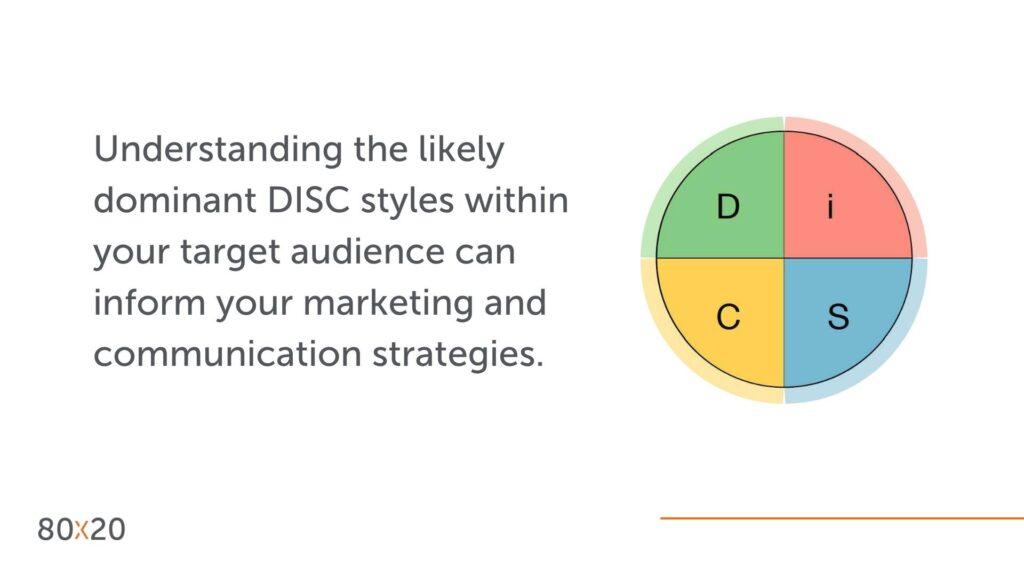
D – Dominance: Results-oriented, assertive, and competitive. These individuals are decisive and prefer quick action.
I – Influence: Social, enthusiastic, and persuasive. They enjoy interacting with others and thrive on positive feedback.
S – Steadiness: Calm, dependable, and supportive. They value cooperation and consistency.
C – Conscientiousness: Detail-oriented, analytical, and systematic. They prioritise accuracy and quality.

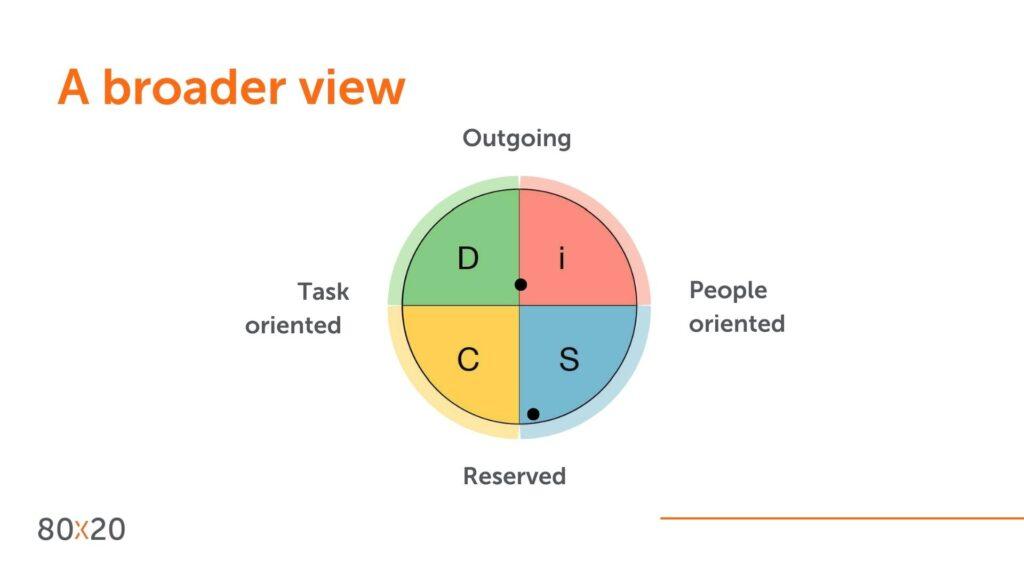
A broader view shows that the DiSC wheel has distinct hemispheres. D & I profiles tend to be outgoing, while S & C profiles are typically more reserved. I & S profiles also tend to be people-focused, whereas D & C profiles tend to be task-oriented.
It’s important to remember that DiSC describes behavioural tendencies, not personality boxes, and there is no ‘best’ style. Each person has a unique blend of all of these traits, but typically one or two tend to dominate their behaviour. DiSC assessments help people better understand their communication styles, decision-making processes, and how they relate to others.
How DiSC works
DiSC profiling works by assessing a person’s behavioural tendencies through a self-evaluation questionnaire. The test typically presents a series of statements or adjectives, and the individual is asked to choose which ones best describe themselves.
The process
- Self-assessment
Participants respond to prompts about their preferences, behaviours, and reactions in various scenarios, usually in a workplace or team context. - Scoring & analysis
Participants’ answers are scored and mapped onto the four DiSC dimensions: Dominance (D), Influence (I), Steadiness (S) and Conscientiousness (C). - Profile generation
The results reveal a behavioural profile, often represented in a graph or wheel, that shows how strongly each trait is expressed. - Interpretation
The profile helps individuals understand:
- How they approach problems
- How they interact with others
- What motivates them
- How they respond to rules, stress, and change
- How they approach problems
DiSC is not a measure of intelligence or ability, but rather a way to understand behavioural styles. It’s widely used in business settings for team building, leadership development, hiring, and, importantly, marketing.
How to apply DiSC to your marketing
Understanding the likely dominant DiSC styles within your target audience can inform your marketing and communication strategies. Here is how you can communicate to each DiSC style through your marketing.
D-style
D Style personalities are dominant, direct, and results-driven. They value efficiency, control and winning. When marketing to a D-Style audience, your messaging needs to be bold, fast and focused on results.
How to approach the D-style with your marketing
Key traits of D-style consumers:
- Competitive and goal-oriented
- Time-conscious: they make quick decisions
- Dislike fluff or small talk
- Motivated by success, achievement, and authority
Marketing strategies for D-types:
Lead with results
Get straight to the point. Highlight benefits, performance, and outcomes right away. For example:
“Grow your revenue by 40% in 3 months. Here’s how.”
Use bold, confident language
An assertive tone works well. Avoid tentative language like “we think…” and use commanding phrases such as:
“Take control.”
“Dominate your market.”
“Get ahead. Stay ahead.”
Prioritise speed and efficiency
Make it easy for them to act quickly. Use direct calls-to-action like:
“Start Now”
“Book Your Free Demo Today”
“Claim Your Advantage”
Show leadership and authority
D-types respect experts and power. Highlight industry leadership, awards, or endorsements from credible figures.
Minimal distractions
Keep your design clean and your copy concise. Don’t overwhelm them with too much detail. They want the essence, fast.
Example messaging for D-types:
“Be the first. Be the best. Discover the tool top-performing CEOs are using to outpace the competition.”
Quick tip:
Avoid emotional appeals or excessive storytelling. They don’t want the why, they want the what and how fast.
I-style
I-style personalities are outgoing, enthusiastic, and people-oriented. They thrive on social interaction, emotional connection, and positive energy. When marketing to an I-type audience, your approach should be fun, vibrant, engaging, and relational.
Key traits of I-style consumers:
- Social, expressive, and optimistic
- Motivated by excitement, recognition, and connection
- Impulsive decision-makers — emotionally driven
- Easily influenced by trends, popularity, and social proof
Marketing strategies for I-types:
Lead with emotion and energy
Use expressive language, humour, and excitement. Make your message feel fun and inspiring:
“Let’s make your dream launch happen, together!”
“Get ready to stand out and shine!”
Create a sense of community, build relationships
Highlight social proof, testimonials, and user stories. Show that other people are already loving it:
“Join 10,000 happy creatives already using this tool!”
Use visually engaging content
I-types are drawn to bright visuals, videos, and storytelling. Use colourful designs, GIFs, or short reels that convey excitement.
Make it social and shareable
Offer incentives for referrals, social sharing, or reviews. Create campaigns that encourage interaction:
“Tag a friend who needs this!”
“Share your story with #MyBigIdea”
Create positive experiences
I-styles want positive experiences. Use your marketing to portray an unforgettable experience
“Pack your bags, adventure is calling! Imagine unforgettable sunsets, laughter-filled nights, and memories that last a lifetime.”
Focus on personal impact
They want to know how this makes them feel better, look better, or connect better, not just what the product does.
Example messaging for I-types
“Say goodbye to boring. Say hello to bold. Start your creative journey with a brand that gets you.”
Quick tip:
Keep the process light and fun. Don’t bog them down with too many details or long decision trees. They want instant excitement and connection.
S-style
S-style personalities are calm, loyal, and supportive. They value security, harmony, and trust. Unlike D- and I-types, S-types prefer a steady, low-pressure approach. When marketing to an S-type audience, focus on building relationships, creating emotional safety, and showing long-term value.
Key traits of S-style consumers:
- Patient, reliable, and risk-averse
- Motivated by stability, connection, and consistency
- Dislike sudden change or aggressive sales tactics
- Loyal once trust is established
Marketing strategies for S-types:
Build trust and reassurance
Use calm, reassuring language. Emphasise support, safety, and reliability. Demonstrate stability:
“We’re with you every step of the way.”
“Trusted by families and businesses for over 15 years.”
Highlight relationships and support
They appreciate knowing they’re not alone. Mention community, customer support, or ongoing guidance:
“Your dedicated success team is here whenever you need us.”
Show long-term value
S-types care about lasting solutions. Emphasise durability, service, and peace of mind over flashy features:
“A solution that grows with you.”
Use warm, friendly visuals
Choose images and colours that feel inviting and gentle. Avoid overly bold or high-pressure styles.
Include testimonials and Case Studies
They want to see how your product or service has helped others, especially in relatable, personal ways.
Example Messaging for S-types
“Looking for a partner you can count on? We’re here to help, today and tomorrow.”
Quick tip:
Avoid pushing them into fast decisions. Instead, nurture the relationship, provide clear information, and give them time to feel comfortable.
C-style
C-style personalities are analytical, detail-focused, and quality-driven. They prefer facts over feelings, logic over hype, and clarity over ambiguity. When marketing to a C-type audience, your messaging should be precise, informative, and trustworthy.
Key traits of C-style consumers:
- Methodical, cautious, and data-driven
- Motivated by accuracy, quality, and expertise
- Dislike vague claims, pressure, or emotional manipulation
- Take longer to make decisions. They need to research first
Marketing strategies for C-types:
Lead with facts and evidence
Back up your claims with logic, data, charts, or third-party validation:
“Certified by ISO 9001 standards.”
“Used by 92% of Fortune 500 companies.”
Be transparent and detailed
Provide technical specs, FAQs, how-it-works guides, and clear pricing. They’ll appreciate the depth and transparency.
Use a professional, neutral tone
Avoid exaggeration or over-the-top promises. C-types are sceptical of hype. Use language that conveys credibility and precision:
“Compare features. Download our detailed product breakdown.”
Showcase expertise
Highlight qualifications, years of experience, or industry leadership. C-types want to buy from experts they can trust.
Give them time and tools to decide
Offer downloadable brochures, comparison charts, whitepapers, or ROI calculators to support their independent decision-making process.
Example messaging for C-types
“Engineered with precision. Backed by data. Trusted by experts.”
Quick tip:
Never rush a C-type. Instead, earn their confidence through information, clarity, and credibility. They’ll often become loyal, long-term customers once convinced.
How to apply DiSC to marketing channels
Understanding DiSC profiles can be a game-changer for marketers because it allows you to tailor your messaging, tone, visuals, and offers to appeal to different personality types. By aligning your marketing strategies with how different people think and behave, you can increase engagement, build stronger connections, and improve conversion rates.
Below are a number of ways that you can apply DiSC to your marketing.
1. Audience segmentation
Use DiSC to segment your audience not just by demographics, but by psychographics. Segmenting how people behave, what motivates them, and how they make decisions can make your marketing messages super-specific for users. For example:
- D-types want fast, results-driven messaging.
- I-types respond to fun, energetic, social content.
- S-types appreciate reassuring, stable, community-focused messages.
- C-types want data, logic, and well-reasoned details.
As an example, if you know that your social media audience is segmented 30% I profile and 70% C profile, you can tailor your content appropriately. Your social media content should be 30% enthusiasm, emotion and relationship-focused and 70% logic, data and evidence-driven. Build this into your content pillars to consistently post content that resonates.
2. Message personalisation
Once you understand the DiSC types of your target audience, you can personalise messaging to match their preferences.
An example might be how you tailor your email subject headers for each type. For I and S profiles, sell the relationship. For D & C profiles, sell facts and results.
Another example might be in the way you construct headlines in your marketing copy:
- Headlines for D-types might say, “Take Control of Your Success Now.”
- For I-types: “Let’s Create Something Amazing Together!”
- For S-types: “We’re Here for You Every Step of the Way.”
- For C-types: “Here’s the Research. You Decide.”
3. Content creation
DiSC can guide everything from ad copy to blog tone to email structure to video content:
- D: Straight to the point, ROI-driven.
- I: Storytelling, vibrant visuals, social proof.
- S: Testimonials, clear steps, a sense of community.
- C: Case studies, technical details, FAQs.
Understanding DiSC can also help you to understand how users consume your content and help you to structure it in a way that resonates with your audience.
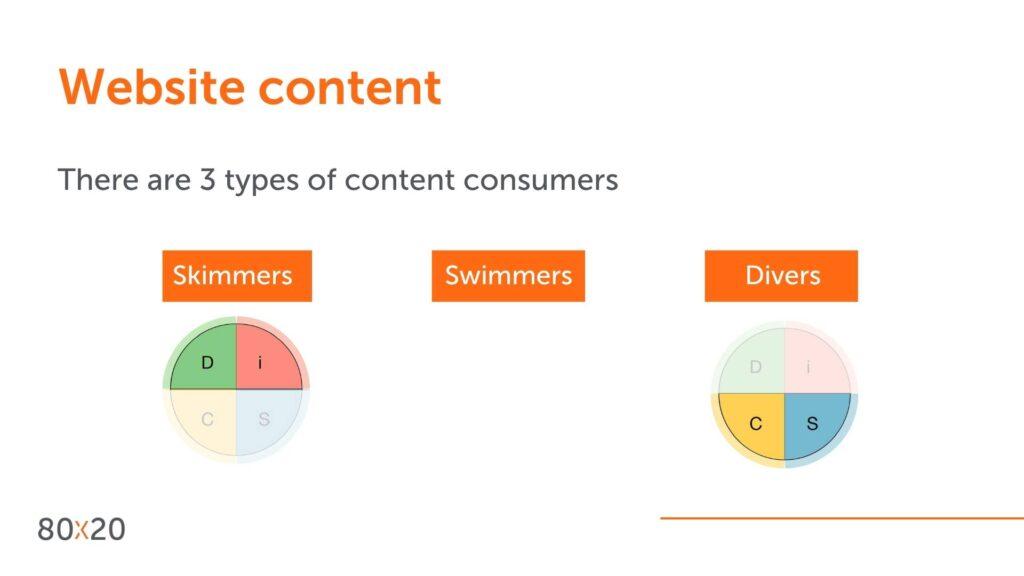
There are three types of content consumers:
- Skimmers scan your content quickly. These users are looking for quick access to information, often focusing on headlines, bullet points, Too Long Didn’t Read (TL;DR) summaries, and key takeaways.
- Swimmers take more time to browse your content before taking action, browsing through sub-sections and potentially watching videos or clicking on links to explore content in more detail.
- Divers are willing to invest significant time in exploring the website, reading in-depth articles, watching videos, and exploring various pages. They are looking for a comprehensive understanding of the content.
How does DiSC apply to Skimmers, Swimmers and Divers? D & I profiles are likely to be Skimmers, whereas Divers tend to be S & C profiles. I & S profiles would also happily fall into the Swimmers category.
When you structure your website with DiSC in mind, it is good practice to design for all four ways people engage. By offering a mix of fast facts, emotional touchpoints, guided reassurance, and deep detail, you can make your website work for everyone.
4. Sales funnels & UX
Understanding DiSC personality styles doesn’t just help with messaging; it gives you powerful insight into how people move through your sales funnel, and what they need at each stage to feel confident converting. Here’s how to fine-tune your funnel for each DiSC type:
- D-types want quick paths to action with minimal fluff.
- Fast, frictionless entry points (e.g., “Get started in 60 seconds”)
- No fluff — just outcomes, timelines, and ROI
- Clear CTAs on every page
- Upfront value proposition (what’s in it for them — right now)
- Self-serve options (e.g., quick quote tools, demos, trials)
Example funnel experience:
- Facebook ad → landing page with “Start Now” CTA → instant trial
- Follow-up email: “You’re 3 steps from [goal]. Ready to go?”
- Appeal to their desire for control, speed, and success.
- I-types enjoy interactive content and community engagement.
- Visually engaging landing pages with videos or animations
- Gamified lead magnets (quizzes, challenges, personality tools)
- Social proof everywhere — testimonials, user-generated content, influencer mentions
- Conversational CTAs (“Let’s do this together!”)
- Community previews (e.g., sneak peeks into groups or Slack communities)
Example funnel experience:
- Instagram story ad → quiz-style landing page → “Find your brand personality”
- Email follow-up: “Here’s what others like you created — come join us!”
- Make it feel exciting and personal. Let them share and connect.
- S-types need reassurance and gradual commitment.
- Warm, clear messaging that emphasises support and reliability
- Step-by-step guidance (“Here’s how it works…”)
- Low-risk entry points (free consultations, no-obligation trials)
- Trust signals (reviews, guarantees, customer support access)
- Nurture emails with a helpful, non-pushy tone
Example funnel experience:
- Referral from a friend → “Let’s explore together” landing page → book a call
- Email: “Here’s what to expect — and how we’ll support you.”
- Focus on connection, comfort, and consistency.
- C-types prefer transparency, detailed product specs, and policies.
- Detailed product specs and side-by-side comparisons
- Clear pricing, policies, and FAQs — nothing hidden
- Downloadable resources (case studies, whitepapers, documentation)
- Professional, data-backed messaging
- Time to decide — no pressure countdowns or pushy CTAs
Example funnel experience:
- Google search → “How it works” page → deep dive product guide
- Email: “Download the ROI calculator and see how it applies to your business.”
- Give them the tools to decide logically. Earn their trust with precision.
By aligning your funnel strategy with DiSC styles, you guide each type of visitor through a journey that feels right to them, whether that means fast action, fun interaction, supportive steps, or thoughtful analysis.
The result?
More engaged leads. Higher-quality conversions. And a healthier, more responsive pipeline.
A note of caution
While implementing DiSC provides many benefits to your marketing, it is important to remember that we’re making educated guesses about audience tendencies. It’s really important that you don’t stereotype, for example, thinking that all salespeople are I profiles, or that all web developers are C profiles. This thinking can rapidly reduce the effectiveness of using DiSC in your marketing communications.
Behaviour-driven marketing wins
At its core, great marketing is about resonance, saying the right thing, in the right way, to the right person.
DiSC profiling gives you a strategic edge by helping you understand not just who your audience is, but how they think, decide, and respond. By tailoring your messaging, design, and funnel experience to match different behavioural styles, you build trust faster, reduce friction, and increase conversions.
Whether you’re writing ad copy, structuring a website, or mapping out a sales funnel, remembering the needs of D, I, S, and C profiles helps you create a marketing journey that feels natural and effective.
When you market with behaviour in mind, you don’t just attract attention.
You build a connection.
You inspire action.
You deliver results.
Take the next steps
Connect with Jag on LinkedIn and message him to receive a link to a free DiSC assessment.
You can also speak to us about building audience personas for your business.
We also recommend a book called ‘Surrounded By Idiots’ by Thomas Erikson. It’s well worth a read.