The reality: why marketing feels like it isn’t working
If you’ve ever questioned whether your marketing is actually delivering a return, you’re in the majority, not the minority.
A significant proportion of SMEs operate without a clear marketing plan. Many business owners aren’t confident in what’s working, and some openly admit they have no idea at all.
- 67% of SMEs operate without a marketing plan
- Nearly half of business owners aren’t sure if their marketing is working
- 1 in 5 admit they have no idea what’s working
On top of that, nearly two-thirds of SMEs say marketing is often handled internally by owners or generalists rather than specialists, which makes consistency and strategic thinking harder to maintain.
Now layer in the environment your marketing exists in.
Every single day, your audience is exposed to somewhere between 3,000 and 25,000 marketing messages. It’s an overwhelming amount of noise. In that environment, a single touchpoint simply isn’t enough. Research suggests that people need to encounter your brand at least 11 times before they trust it enough to take action.
So when businesses say, “our marketing isn’t working,” it’s rarely because marketing itself is ineffective; it’s because the approach lacks the structure required to cut through. If you’re asking ‘why your marketing isn’t delivering ROI,’ this blog is for you.
TL;DR
- Most SMEs struggle with marketing Return On Investment (ROI) because they lack strategy, clarity, and alignment
- Marketing success isn’t about doing more; it’s about doing the right things, consistently
- ROI comes from aligned messaging, defined audiences, and meaningful measurement
- Stop focusing only on vanity metrics and track signals of intent and revenue
- The key shift: ROI is a byproduct of alignment—not individual tactics
Watch: Why your marketing isn’t delivering ROI
Why ROI feels so elusive
ROI can feel elusive for many businesses for a number of reasons. The most common reasons we see are:
Confusing activity with strategy
One of the most common issues is the assumption that doing marketing activities is the same as having a strategy.
It’s easy to fall into this trap. You launch a new website, start posting on social media, maybe run a few digital ads, and it feels like progress. But these are all tactics. On their own, they don’t guarantee results.
A true strategy answers three critical questions:
- Who are we trying to reach? (see point three below)
- What problems do we solve for our audience?
- Why should they choose us over alternatives?
Without these answers, marketing becomes reactive. Different activities happen in isolation, often with no clear connection or direction. The result is effort without impact.
Lack of clear, measurable objectives
Another major barrier to ROI is the absence of clear goals.
Many businesses invest in marketing without defining what success actually looks like. That leads to:
- No clear KPIs
- Inconsistent tracking
- Little or no structured review process
Without measurement, there’s no feedback loop. And without a feedback loop, improvement is almost impossible.
Effective marketing requires clarity not just in execution, but in evaluation.
No clearly defined audience
This is arguably the most critical issue, and one of the most overlooked.
If you can’t clearly articulate who your ideal customer is, your marketing will inevitably become too broad. And when messaging is too broad, it fails to resonate and it fails to deliver.
A well-defined audience includes:
- Demographics (industry, role, size, etc.)
- Pain points and challenges
- Motivations and desired outcomes
The more specific you are, the easier it becomes to create messaging that feels relevant and compelling.
When you try to speak to everyone, you end up connecting with no one.
Disconnected channels
Many SMEs are active across multiple channels: social media, email, websites, or perhaps paid ads, but these efforts are often disconnected. Disconnected from each other or disconnected from business goals.
This appears as:
- Inconsistent messaging across platforms
- Channels that don’t support each other
- No clear journey from first interaction to conversion
Instead of guiding prospects forward, this creates friction and confusion.
Strong marketing doesn’t rely on individual channels performing in isolation. It depends on those channels working together to move someone from awareness to action.
Measuring the wrong things
It’s easy to focus on metrics that look good but don’t actually drive business performance.
These include:
- Likes
- Impressions
- Followers
- Website traffic
While these metrics are useful for understanding visibility, they don’t tell you whether your marketing is generating revenue.
To understand ROI, you need to go deeper, into metrics that reflect intent, conversion, and long-term value. More on that later.
The shift: understanding the modern buyer journey
From linear funnels to complex journeys
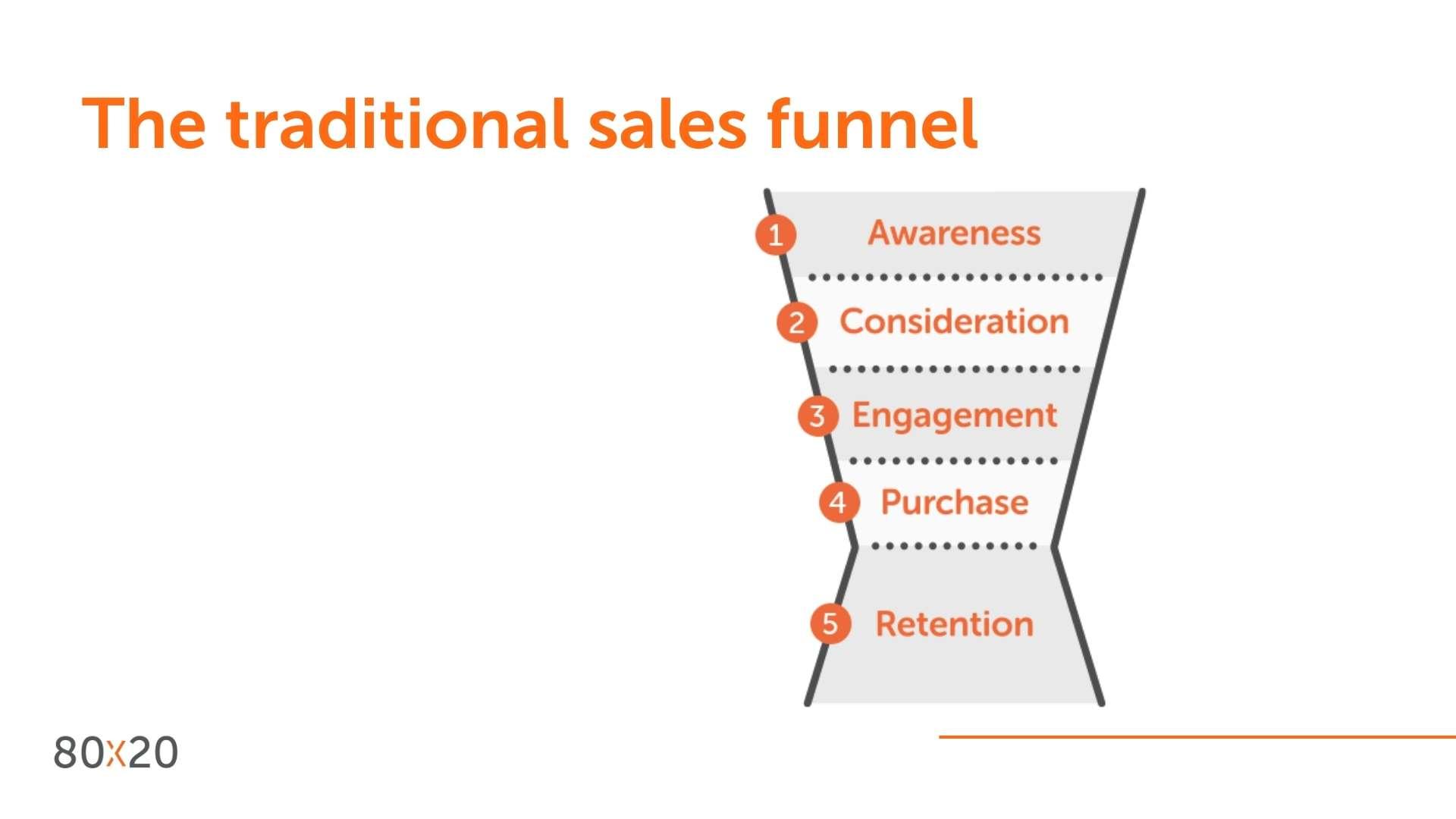
Traditionally, marketing followed a relatively simple, linear funnel:
- Awareness
- Consideration
- Engagement
- Purchase
- Retention
For example, someone buying a car might:
- Become aware of brands like BMW or Audi
- Research options online
- Visit showrooms and test drive vehicles
- Make a purchase decision
- Return later for servicing or upgrades
Each stage had a clear role, and each channel had a defined purpose.
- At the awareness stage, social media and PR might be channels to help potential customers become aware of you.
- At the consideration stage, your website will be key for evaluating options
- At the engagement stage, your potential customer may email you or call you to ask questions
- A purchase may happen online or in-store
- Customers may be retained through excellent customer service, email marketing or direct mail campaigns.
The reality: the “messy middle”
Today, that linear journey has broken down. Instead, customers move unpredictably between channels and stages. They might visit your website, look at your social channels, read reviews and recommendations or interact with you directly as they explore, evaluate, reconsider, and loop back multiple times before making a decision.
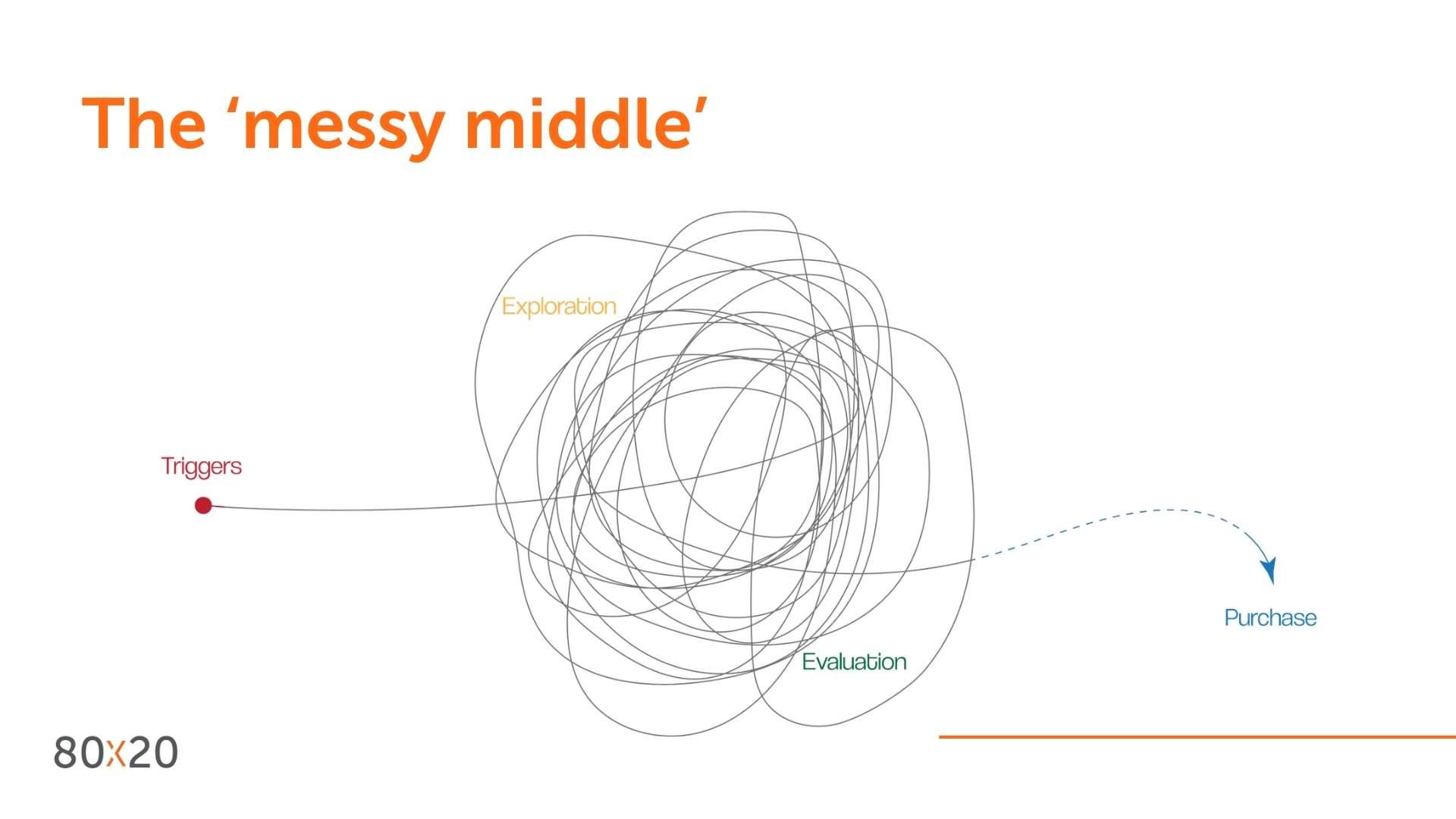
This is often referred to as the “messy middle”, where the path to purchase becomes non-linear and highly dynamic.
In this environment, having a presence isn’t enough. You need consistency, repetition, and clarity across every interaction.
Why brand matters more than ever
When customers are faced with endless options, they don’t always make purely rational decisions.
Instead, they rely on shortcuts:
- Familiarity
- Trust
- Perceived credibility
That’s what your brand provides.
And a brand is far more than a logo or visual identity; it’s the complete experience of your business:
- Your messaging and positioning
- Your tone of voice
- Your values and personality
- The consistency of your communication
A strong brand reduces friction in decision-making. It makes it easier to choose one business over another.
Aligning your marketing: a practical framework
We developed our SOLAR 7 model to help businesses understand how they can get the most out of their marketing, and to show them how each channel works together to deliver ROI.
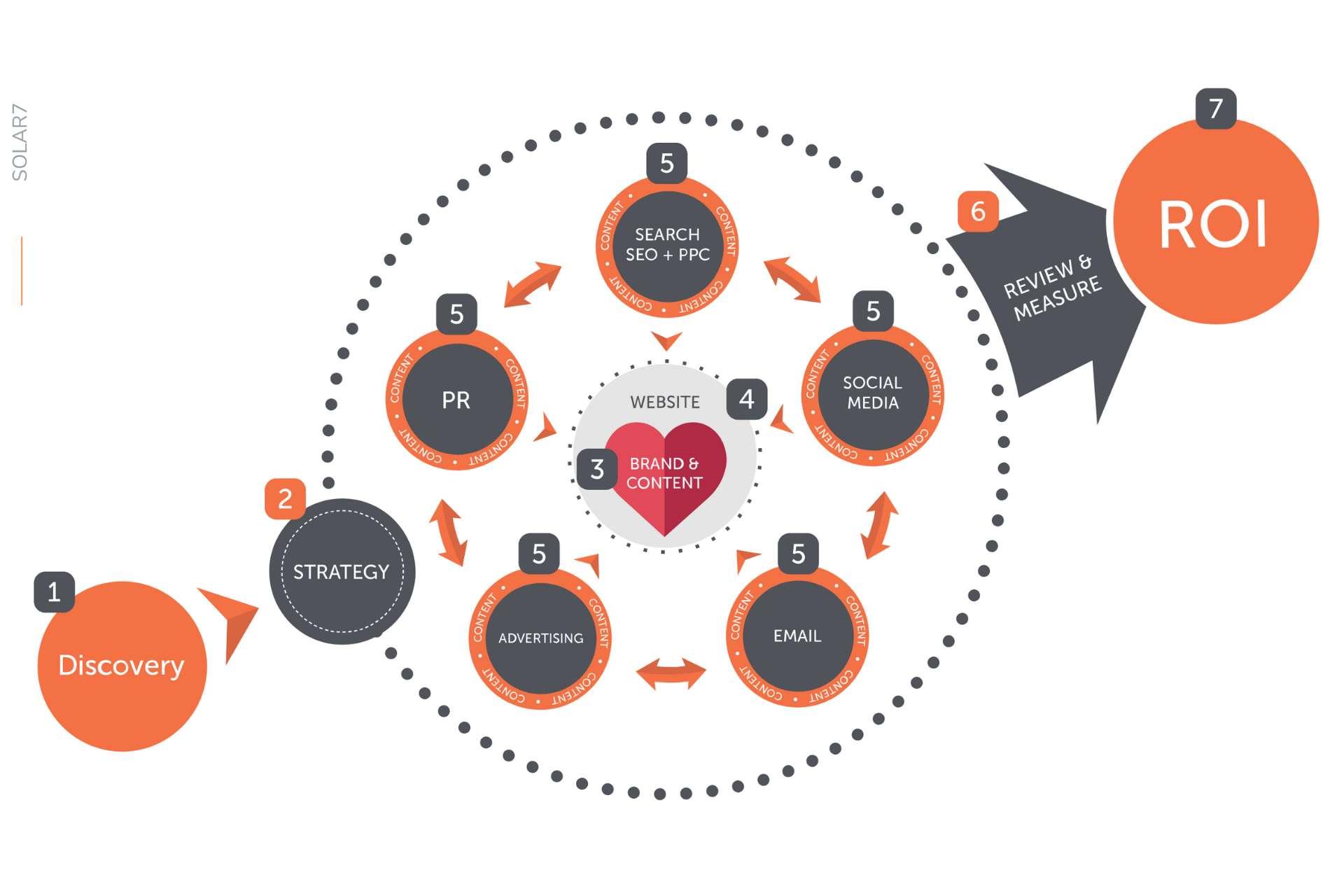
You can read more about our SOLAR 7 process here.
Common marketing mistakes at each stage of SOLAR 7
We see a lot of the same mistakes at each stage of the SOLAR 7 model. Here are the most common mistakes to avoid.
1. Strategy
As we’ve said before, tactics do not equal a strategy. A strong strategy defines:
- Who are you targeting
- Where you sit in the market
- How are you going to win against competitors?
This becomes the foundation for every decision that follows.
2. Brand
Your brand translates your strategy into something your audience can understand and connect with. It’s not just a logo, it’s much more than that. It encompasses your messaging, values, tone of voice and what it says about you.
Your brand should:
- Speak directly to your ideal customer
- Reflect your positioning
- Be consistent across all touchpoints
A well-defined brand builds trust before a conversation even begins.
3. Website
Your website is often your most important conversion tool.
It needs to:
- Clearly communicate what you do and who it’s for
- Address your audience’s key pain points
- Guide visitors toward a clear next step
A beautifully designed website that lacks clarity will underperform compared to a simple site with strong messaging.
4. Channels
Your choice of channels should be intentional. Rather than trying to be everywhere, focus on:
- Where your audience actually spends time
- Channels that support your sales process
- Consistent messaging across all platforms
The goal is not presence, it’s consistency and effectiveness.
5. Measurement and review
Without measurement, there is no improvement. But if you’re measuring the wrong things you can’t see the whole picture and you can’t make strategic decisions. The key is measuring the right things.

What you should actually be measuring
To properly understand ROI, you need to track metrics across the full customer journey and use them not only as an indicator of what is working, but as a predictor of success. Here are some metrics to track in your marketer’s report or dashboard.
Awareness (visibility)
These metrics help you understand how visible your brand is:
- Impressions
- Reach
- Frequency
- Share of voice
- Brand search volume
- Audience growth
- CPM (Cost per 1,000 impressions)
- Brand recall strength (survey-based)
- Direct traffic volume
- Branded queries in Search Console
- Referral traffic
- PR coverage and media mentions
- Backlink volume
They are important, but they don’t indicate revenue on their own.
Engagement (interest)
These show how people are interacting with your content:
- Click-through rates
- Time on page
- Engagement rate
- Scroll depth
- Social interactions
- Video completion rates
- Email open and click rates
- Engagement rate in GA4
- Content shares/saves
- Comments sentiment
- Email unsubscribe rate
These metrics indicate whether your messaging is resonating.
Consideration (intent)
These are stronger buying signals:
- Returning visitors
- Pages per session
- Downloads or sign-ups
- Product or service page views
- Email subscribers
- Comparison page views / pricing page visits
- Lead magnet conversion rate
- Quote requests
- Demo bookings / consultations booked
They suggest that someone is actively evaluating your offering.
Conversion (revenue impact)
These are critical for measuring ROI:
- Leads generated
- Cost per lead
- Conversion rates (visitor to lead, lead to customer)
- Cost per acquisition
- Pipeline value
- Revenue generated
- Sales cycle length
- Marketing Qualified Leads (MQLs)
- Sales Qualified Leads (SQLs)
- Revenue per lead
- Return on ad spend (ROAS)
- Gross profit (not just revenue)
- Conversion rate by channel
- Abandonment rates (cart/form drop-off)
This is where marketing directly connects to business performance.
Retention (long-term value)
Often overlooked, but hugely important:
- Customer retention rate
- Repeat purchase rate
- Customer lifetime value
- Average order value
- Churn rate
- Upsell and cross-sell revenue
- Net Promoter Score (NPS)
- % revenue from existing customers
Retention is often more cost-effective than acquisition and more profitable over time.
Real profit is often made after the first sale.
Attribution (what’s actually working)
Understanding attribution is key to understanding how channels contribute to your business. You need to understand:
- Where your enquiries come from. Identify the channel responsible.
- Channel-specific conversion rates. Does one channel convert better than others? This can also be used to help identify potential issues if conversion rates suddenly drop from one channel, and reallocate marketing spend if required.
- Assisted conversions. As we’ve seen with the messy middle, multiple channels can play a part in the conversion. Assisted conversions give some credit to channels that assisted before the conversion.
- How many touch points do your customers have before they convert?
But do remember that some channels will deliver conversions better than others, for example, Google Ads are typically more conversion-focused than organic social.
Modern marketing is rarely driven by a single touchpoint. Attribution helps you see the bigger picture and allocate your marketing budget accordingly.
A real-world example of alignment
Mitchells of Mansfield, a haulage company, provides a strong example of what alignment looks like in practice.
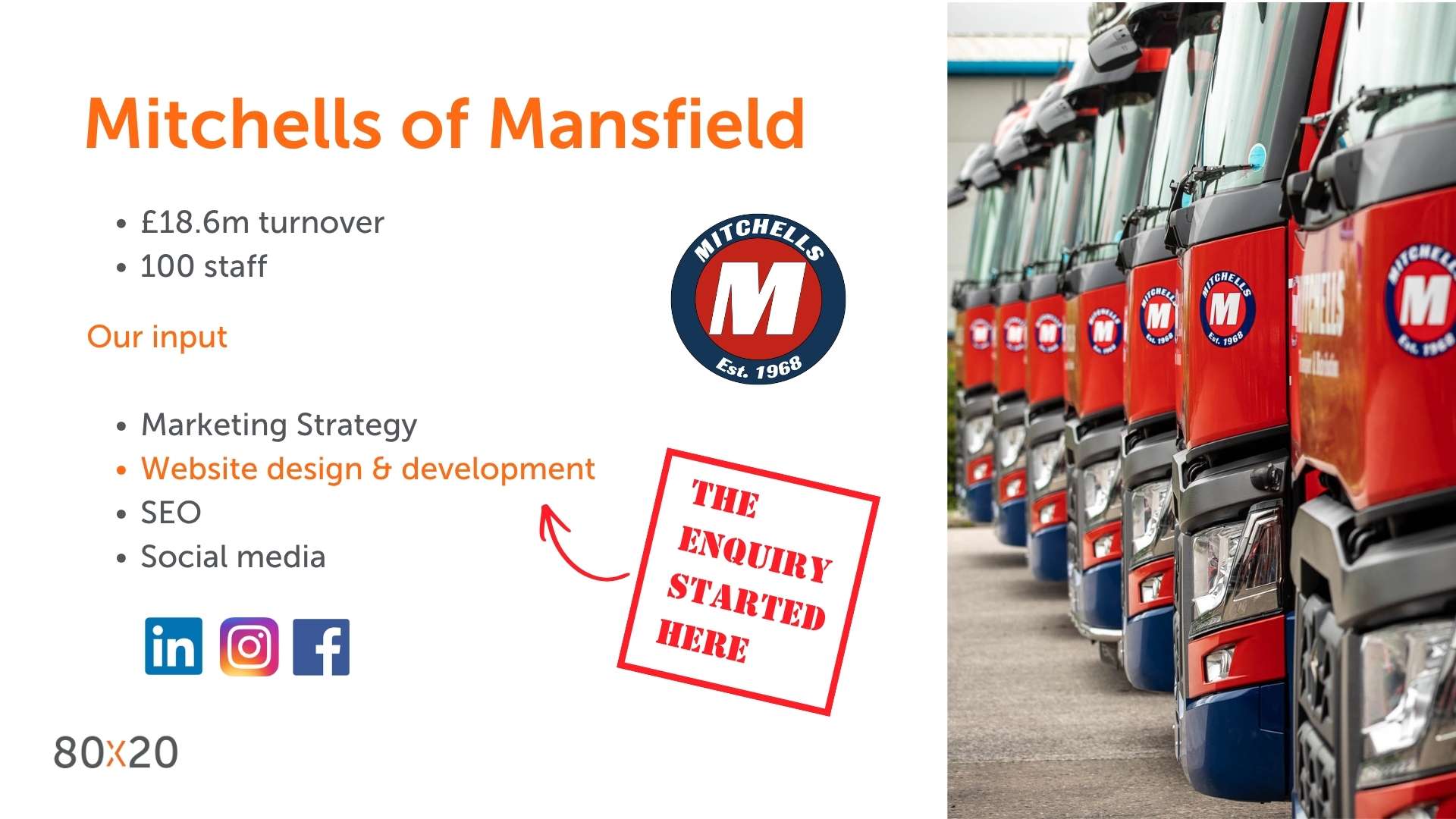
Their original enquiry was for a new website, but they realised that there was a lack of strategy in place.
Instead of focusing on isolated tactics like “just building a website,” they aligned their:
- Brand messaging
- Website
- Social media
- SEO
- PR
Around a clear strategy.
The result was consistent, sustainable growth: 10% year-on-year growth over seven years
Even in an extremely challenging economic environment, in which over 1000 haulage businesses have closed their doors over the last couple of years.
What most businesses still overlook
ROI isn’t just short-term
One of the biggest limitations of ROI is that it often encourages short-term thinking.
But marketing also delivers long-term value through:
- Brand recognition
- Trust
- Customer loyalty and repeated purchases
Not everything that matters can be measured immediately, but it still contributes to growth.
Attribution is getting harder
Customer journeys are becoming more complex:
- Multiple devices
- Multiple channels
- Longer decision cycles
This makes attribution more difficult, but also more important to understand.
Final takeaway
If your marketing isn’t delivering ROI, the issue is rarely a lack of effort.
Lack of alignment is usually the cause.
When:
- Your strategy is clear
- Your audience is well-defined
- Your messaging is consistent
- Your channels work together
- Your measurement focuses on real outcomes
ROI stops being something you chase and becomes something you generate.