
Social media. It’s an important marketing channel. But how do you know you’re using it in the right way for your business?
At our latest 80×20 event, our director, Jag Panesar, was joined by marketing strategist Ian Kirk from Opportunity Marketing. Jag and Ian talked about how your marketing strategy informs your social media content and applied this to a real business.
What you will learn:
- How knowing exactly what you offer (and how you stack up against competitors) helps shape your social content.
- Why really understanding your audience changes everything – from the platforms you use to how you talk to people.
- How to turn your key messages into content pillars that make posting easier and more impactful.
- And finally, how to bring it all together so your social media actually drives business results.
The big question
If your marketing budget dropped 80% where would you focus?
The chances are that you’re thinking of specific marketing activities or channels, such as PPC, social media or SEO.
It’s a sign that you don’t have a wider marketing strategy that you can fall back on.
The answer
The answer is to get the biggest return from your marketing budget.
This could be by:
- Focusing on the segments of your audience that buy the fastest, or spend the most money.
- Promoting products or services that are either the most popular or the most profitable.
- Concentrating on sharing messages that prospects can easily remember and repeat.
- Communicating the one position that you own in the marketplace.
This is what having a marketing strategy is all about.
Applying this to a real-life case study
The business we have chosen to apply this to is 888 Safety Solutions, a one-man health and safety consultancy based in Wakefield.
Business background
- The business is in its start-up phase (roughly 18 months old).
- Its focus has been on building a new client base.
- They have invested in a new website
- Marketing activity to date has included regular networking and a small amount of social media activity.
Reviewing them from a strategic perspective allows us to filter this through to their social media activity.
Solar 7
Solar 7 is our process for achieving marketing success and can be applied to any business.
This model covers seven key stages, from discovery and strategy to brand, content, and review.

1. Discovery
Understand your business goals, target audience, and competitive landscape.
Conduct a thorough analysis of your current marketing efforts.
2. Strategy
Develop a comprehensive marketing strategy aligned with your business objectives.
Set clear goals and KPIs to measure success.
3. Brand and Content
Establish a strong brand identity and messaging.
Create high-quality content that resonates with your target audience.
4. Website
Build a user-friendly website that drives traffic and conversions.
Optimise your website for search engines and mobile devices.
5. Traffic Generation
Implement effective SEO, PPC, and social media marketing strategies.
Use email marketing to nurture leads and drive sales.
6. Review and Measure
Track key performance indicators (KPIs) to measure the effectiveness of your marketing efforts.
Use analytics tools to gain insights into customer behaviour and preferences.
7. Return on Investment (ROI)
Calculate the ROI of your marketing campaigns to justify your budget.
Continuously optimise your marketing strategies to improve ROI.
Four pillars of a sound marketing strategy
There are many things that can be considered when creating a marketing strategy, but to simplify the process, we’ve boiled it down to four key pillars:

Your Offering
Understanding what it is you are offering provides clarity both for you and your customers. To better understand your offering, consider these questions:
- What products or services are you offering?
- What is your core offering? What are you known for, or what would you like to be known for?
- How is your offering segmented? How can your products or services be subcategorised?
- Which of your products or services are the most profitable?
- Which products or services are the easiest ways in? These might not be the most profitable, but they can easily get you in with a customer, where you can cross-sell or upsell from within. These are likely to be low-effort, quick wins.
We go back to the word clarity. It’s really important to have clarity in what you’re offering because for many people in business, it’s not that clear. When most people start out in business, they might start with 1-4 products or services. Over time, new revenue-generating opportunities come along, adding more products and services.
What happens is that the list of products and services doesn’t stay clearly segmented, but becomes a bit muddled. The result is that your target customers are confused about what you offer, or what it is that you do, which is a challenge.
A clear offering makes it much easier for potential customers to buy from you.
How can this be applied to 888 Safety Solutions?
888 Safety Solutions was receiving lots of training enquiries, but that’s not what he wanted to be known for. Training is time-consuming, and it creates capacity issues.
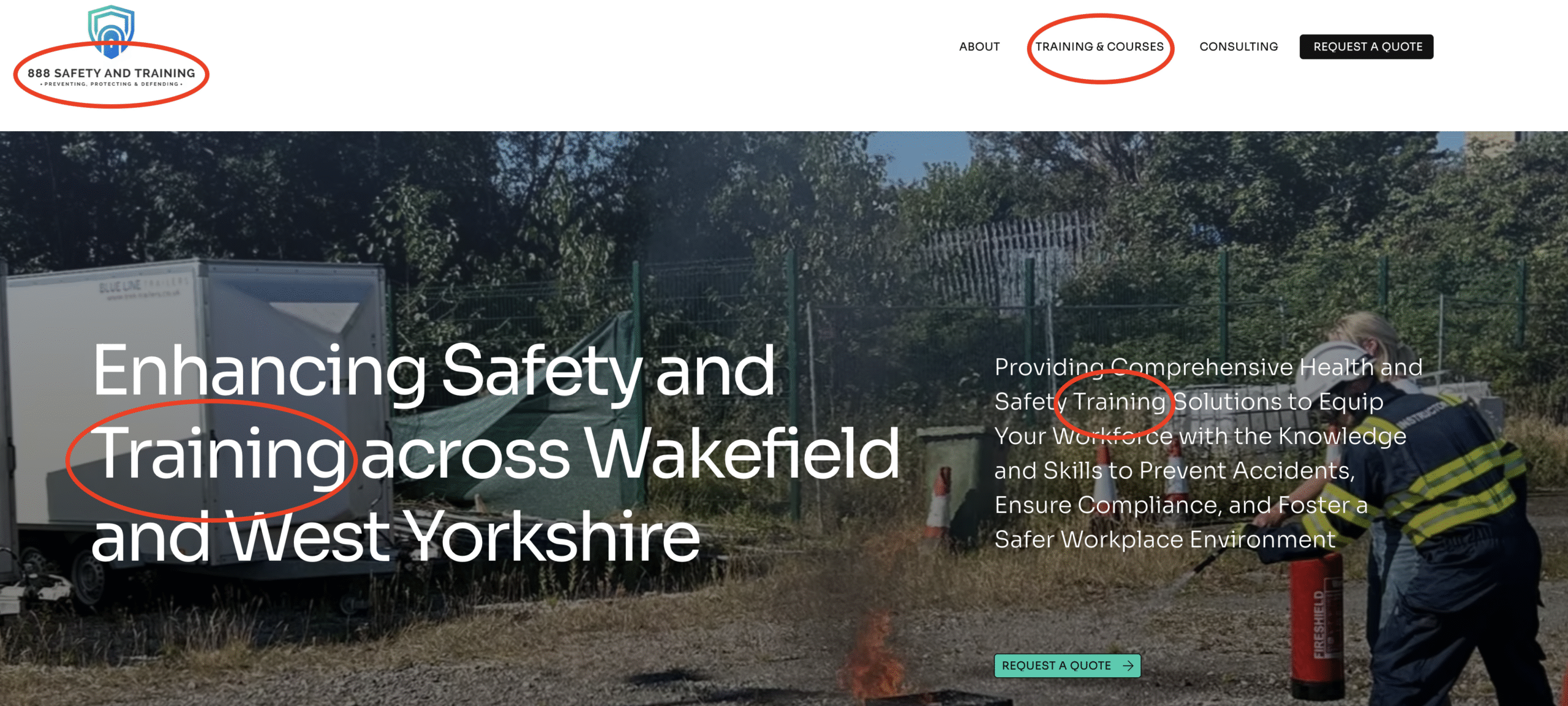
Looking at his website, it’s easy to see why. Training is referenced heavily ‘above the fold’
- In his logo and branding
- In his URL
- In his Meta page Title
- In his Headline
- In his main navigation
- In his body copy
- Even his images look like somebody is receiving training
Our recommended focus was to tweak the brand name from 888 Safety & Training to 888 Safety Solutions and to better align his core offering to focus on Health & Safety Consultancy and Fire Safety, of which training is a small, but not a core offering.
Understanding your audience
Understanding who your customers are and who is buying from you is key to identifying where other similar people may be reached.
If you’re not clear on your target audience, consider these questions:
- Who currently buys from you? How can they be categorised?
- Describe in detail what your ideal customer looks like. You might consider demographics, interests, industries, geography and size of organisation.
- Who would you like more of?
- How do they behave and buy? What drives them to purchase?
- What pain points do they have?
A lot of business owners are reticent to name and define their target audience for fear of alienating potential customers. There will be customers of yours that don’t fit who you want to target, but your products or services are still useful to them, but from a marketing perspective, if you only have a finite amount of resource to spend on communicating with your target audience, it makes sense to speak to as many people who are like your customers, than worry about alienating the small number of potential customers that don’t quite fit
To make sure that your messaging hits home, it’s crucial to be clear on who you are communicating to.
How can this be applied to 888 Safety Solutions?
888 Safety Solutions was getting lots of enquiries for smaller projects, which, like the training enquiries, were time-consuming and not very profitable.
Their new target audience looks like this:
- Sectors: Warehousing & logistics, Engineering, Manufacturing
- Job Roles: Managing Directors and Operations Managers (D’s & I’s on the Disc profile)
- Turnover: £250,000 – £20m
- Size of Organisation: 5-200 staff
By targeting companies of this size and turnover, and in these industries, we know that they need regular health and safety services and they likely have the budget, without already having an employee in-house dealing with this.
How are you positioned?
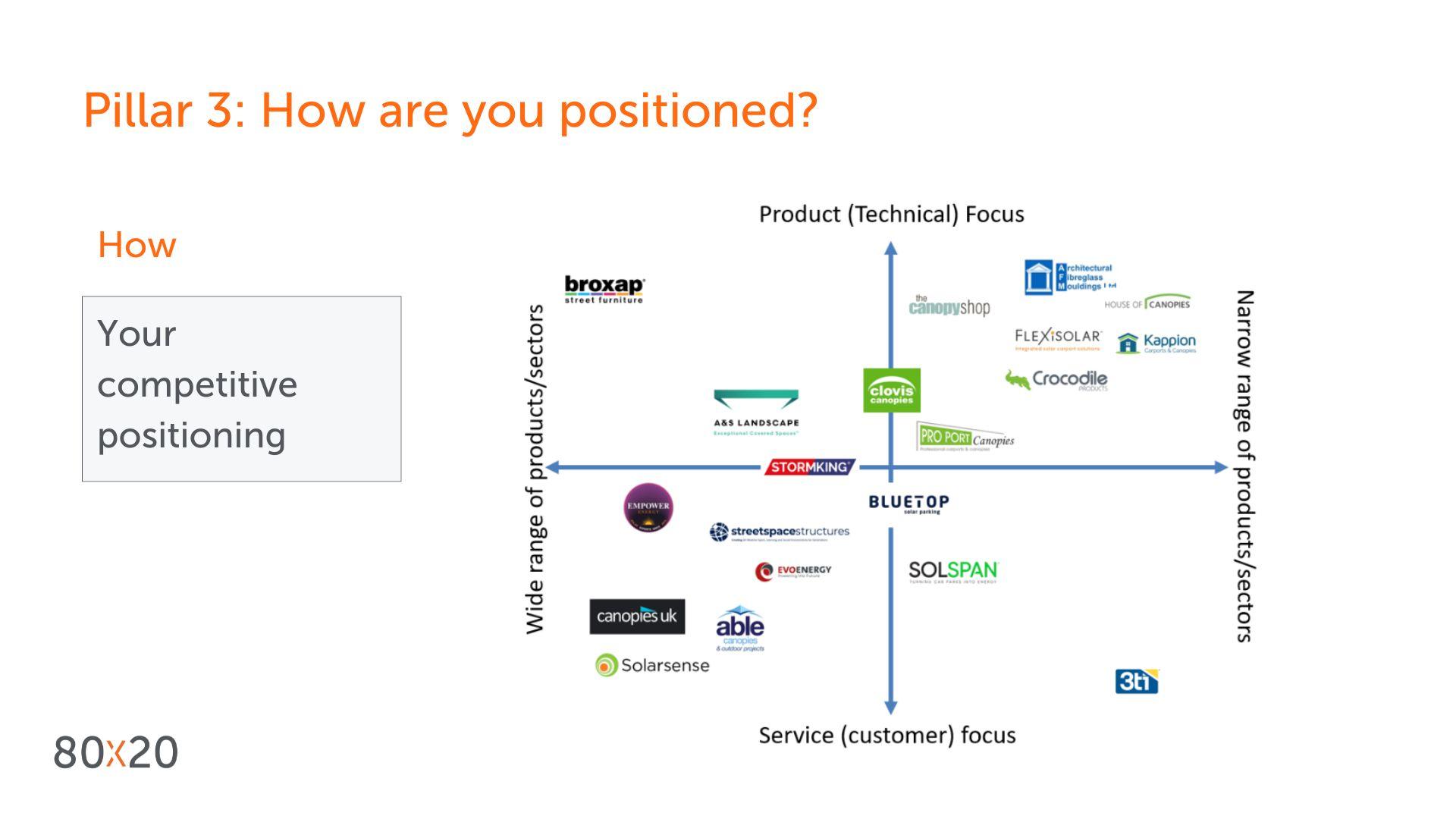
Understanding how your business fits into the competitive landscape helps you with your messaging and how you can differentiate yourself from the crowd.
Using this example matrix, we can see that in this landscape, there are clear white areas where there is less competition, where a company in this field may wish to position itself.
Not a lot of businesses we encounter have conducted this exercise, and we encourage you to do so.
How to set up your competitive matrix
- Set up your axis left to right and top to bottom. The labels for each can represent anything as long as each end of the axis is an opposite, e.g Price (low to high). Common axes pairings might include:
- Price vs. Quality: A classic positioning model where the x-axis represents price (low to high) and the y-axis represents quality (low to high).
- Innovation vs. Market Share: This axis pair helps position companies based on the newness of their offerings versus their current dominance in the market.
- Geographic Reach vs. Product Breadth: Useful for businesses with physical locations, this axis pair contrasts how widely they operate geographically with how many products or services they offer.
- Low-Cost vs. Premium: A variation of the price axis, this can be used to distinguish between budget-friendly options and luxury brands.
- Customer Focus vs. Product Focus: This axis can separate companies that prioritise customer service and experience from those that focus more on the core product or features.
- Online vs. Brick-and-Mortar: This is especially relevant for retail businesses, contrasting their primary sales channel.
- Plot on the matrix where you would position yourself, as well as your competitors. Remember that your competitors may be in your locality or region, you may have competed directly for business, or they may be competing for the same online space, e.g. Organic search rankings or Google Ads.
Questions to ask yourself about your positioning might include:
- Are you positioned where you want to be?
- Have you positioned yourself there, or has somebody else?
- Who are you competing with?
- What differentiates you, or could differentiate you?
How can this be applied to 888 Safety Solutions?
With this in mind, we applied this to 888 Safety Solutions and identified that there is a gap where Health and Safety services are paired with HR services, so there was an opportunity to partner with HR professionals.
It also identified that having a range of outsourced and retained options was the best way to go. With his background as a firefighter, he was able to differentiate himself as somebody who has seen it all when Health and Safety goes wrong.
Messaging Alignment
Aligning your messaging ties all of the previous research together. Without knowing what you offer, to whom and how your business is positioned, you can’t effectively craft a compelling message to your target audience.
Key things to think about include:
- Your purpose: why do you do what you do? Why did you start the business?
- What are your core values, as a person and as a business?
- What sets you apart from your competitors?
- What triggers your customers to buy and drives their decision to buy?
- What language do they speak?
Messaging doesn’t just relate to words. It can direct the types of images and visuals that you use to support the words on the page.
How can this be applied to 888 Safety Solutions?
Applying this to 888 Safety Solutions, we can begin to craft their key messages:
- Protecting business: your staff, your premises and your reputation
- Reliable outsource compliance partner available whenever required. Expert advice ‘on tap.’
- Great value and cost-effective compared to an in-house solution
- Legal compliance, peace of mind. Helps you sleep better at night. We have you covered.
- Ex-fire service: has seen what happens when things go wrong
With all of that in mind, how do we take our overarching strategy and implement this through our social media channels?
How to choose the right platform?
There are many more social media channels to choose from these days, from the big players (Meta, X, LinkedIn, TikTok) to emerging, niche platforms.
With this shift, social media is becoming much more fragmented. To choose the right platform for your business, you need to make a choice based on your audience AND the resources you have available AND your business goals.
The 3R test is a useful framework:
Reach: Can I reach my target audience here?
Resource: Can I maintain this platform consistently?
Return: Does this platform align with my business goals?
For 888 Safety Solutions, as a relatively new one-person business that has limited time and cash flow (a problem for most businesses) and a desire to get in front of Managing Directors and Operations Managers, the answer would be LinkedIn, but not a LinkedIn company page, but a personal profile.
Personal LinkedIn profile assessment.
Assessing the personal profile of Matt from 888 Safety Solutions, there are lessons for anybody adopting this approach.
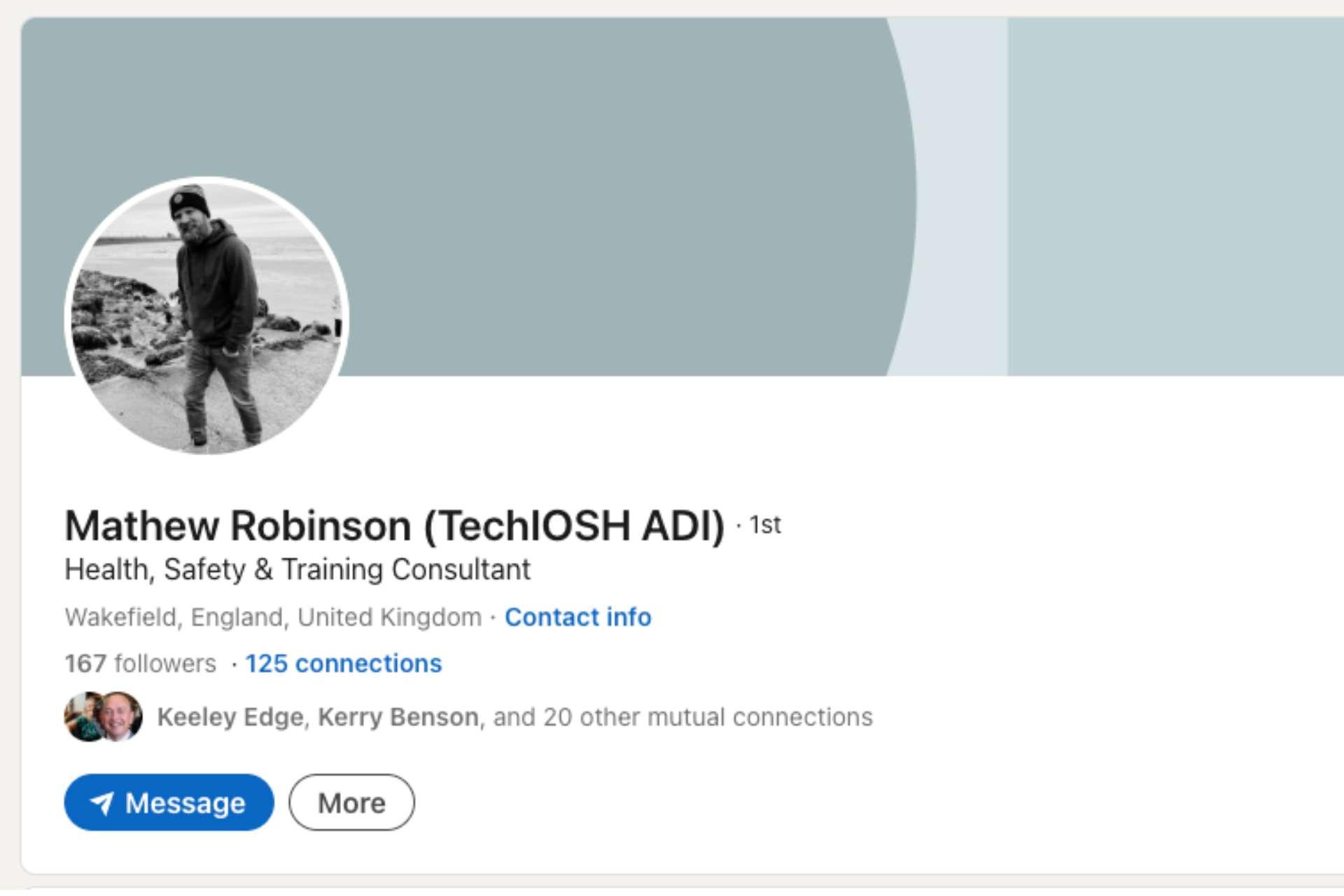
- Use clear headshots in your profile image. Professional images from the shoulders up work best.
- Use a profile banner image. This offers prime LinkedIn real estate to promote your key messages.
- Complete your headline. LinkedIn provides 22o characters to speak directly to your audience. Rather than say what you do, talk about what outcomes you can provide.
- Make sure to complete all sections on your profile. LinkedIn is one of the few social media sites that will make you less searchable if you have incomplete sections.
What should 888 Safety Solutions post about?
Most businesses we speak to struggle with
- Fear of posting
- Not knowing what to say
- Worrying about repetition
- Thinking every post needs to be perfect
- Comparing themselves to others
- Not knowing how many times to post or what ratio
In terms of how often to post, that will be platform-specific. Sticking to LinkedIn, we would recommend posting 2-5 times per week on a personal profile. This keeps you in the sweet spot without completely overwhelming you.
A good rule of thumb is to post 20% educational content and 80% relatable and entertaining content. Quality over quantity should be your goal.
To help with your content goals and to address a lot of these objections, you should create content pillars. A content pillar is a theme that you can use to direct the content that you create.
But how do you create a content pillar? You use your key messages.
Content pillar 1: Protect your business
The purpose of this content pillar is to educate and remind business owners that safety isn’t a box-ticking exercise. It’s about protecting what matters the most.
Example posts may be:
- Real-world examples of avoidable incidents and lessons learned
- “Three oversights that can cost your business its reputation”
- “What protection really means in Health & Safety terms”
- Mini case studies showing how proper systems prevented disruption
Content pillar 2: Your outsourced safety partner
The purpose of this content pillar is to position 888 Safety Solutions as a trusted extension of the clients’ team, not just a consultant.
Example posts may include:
- “When a client calls at 6 pm on a Friday, we answer”
- “Why having advice on tap makes all the difference?”
- Showcase ongoing partnerships & testimonials. Demonstrate social proof.
- Behind-the-scenes images and video show how retainer clients are supported day by day.
Content pillar 3: Smarter value, not just lower cost
This content pillar communicates that an outsourced solution isn’t about cutting costs; it’s about getting expertise and flexibility for less.
Example social media posts for this content pillar may be:
- “Why do most companies overpay for safety, they underuse?”
- “Here’s what an outsourced solution gives you that an employee can’t.”
- Carousel comparing in-house vs outsourced safety solutions.
- “It’s not about being cheaper, it’s about being smarter.”
The key with this content pillar is to demonstrate the value that an outsourced solution can provide.
Content pillar 4: Legal compliance & peace of mind
The purpose of this content pillar is to build trust and reassurance in 888 Safety Solutions’ thorough and proactive approach to health and safety compliance.
Example posts for this content pillar may include:
- “The compliance checklist that lets most MDs sleep better at night.”
- Explainer posts, e.g. “How Health & Safety compliance protects contracts and reputation
- “We don’t just help you meet your legal requirements, we help you exceed it.”
- “What peace of mind looks like in Health & Safety terms.”
Content pillar 5: Experience the saves lives
The purpose of this content pillar is to humanise the brand and demonstrate genuine experience-based authority.
Example posts may be:
- “I’ve seen first-hand what happens when corners are cut.”
- Short stories from the fire service (non-graphic, focused on lessons learned)
- “Why prevention beats reaction every time.”
- “The real reason why I started 888 Safety Solutions.”
Recap
So there you have it, a real-life example of how to apply an overarching marketing strategy to create content for your social media channels. There is an awful lot that we could have covered, especially with the number of social media channels.
With so many channels available, we see an awful lot of overwhelm. If that’s how you’re feeling, our advice is to think about the questions in this article to bring a little clarity. If you have limited resources, narrow your focus and cut deep. Doing a small number of things well beats doing many things not so well.
As your business grows and resources allow, you can begin to build out your marketing activities, whether that’s more social media platforms or additional marketing channels.
This is how you win in 2026.