Artificial intelligence has transformed content creation.
What once took hours can now be done in minutes. Need a LinkedIn post? Ask ChatGPT. Need content ideas? Ask Gemini. Need a month’s worth of posts? Countless AI tools will generate them for you.
The problem is that everyone else is doing the same thing. Your competitors have access to the same tools as you.
Spend five minutes scrolling through LinkedIn, and you’ll start noticing patterns. The same storytelling structures. The same motivational language. The same polished tone. The same predictable conclusions.
As more professionals use AI to write LinkedIn posts, we’re seeing a growing problem: everyone is beginning to sound the same.
This isn’t an anti-AI article. At Xpand, we use AI every day. We use it for research, brainstorming, content planning, analysis and productivity. The issue isn’t AI itself. The issue is how people are using it.
Too many professionals are allowing AI to replace their thinking rather than support it. The result? Generic content, weaker personal brands, lower engagement and missed opportunities to build genuine authority.
In this guide, we’ll explore how to use AI for LinkedIn posts without losing your voice, your expertise or what makes you different.
TL;DR: How to use AI for LinkedIn posts effectively
- Use AI to support your thinking, not replace it.
- Start with your own opinions, experiences and expertise.
- Avoid generic AI writing patterns that make posts feel robotic.
- Use voice notes and conversations as content sources.
- Train AI using your previous posts, tone of voice and audience.
- Give AI examples of content you like and dislike.
- Use AI to challenge your thinking, not just agree with it.
- Create first drafts with AI, but add your own stories and opinions.
- Repurpose strong ideas into multiple content formats.
The professionals getting the best results from AI aren’t using it to write for them. They’re using it to think better, create faster and communicate more effectively.
Catch up our 80×20
Why so many LinkedIn posts sound the same
LinkedIn has become flooded with AI-generated content.
The challenge isn’t necessarily that AI content exists. The challenge is that AI is inherently predictive at its core. Large Language Models (LLMs) operate fundamentally by calculating probabilities to predict the next logical piece of data in a sequence.
It generates content based on those predictions or patterns, and the more people rely on those patterns, the more uniform the content becomes.
You may have seen examples like:
- “I thought this was the answer. I was wrong.”
- “It’s not X. It’s Y.”
- “They acknowledged it. They owned it.”
- “AI isn’t the threat. Falling behind is.”
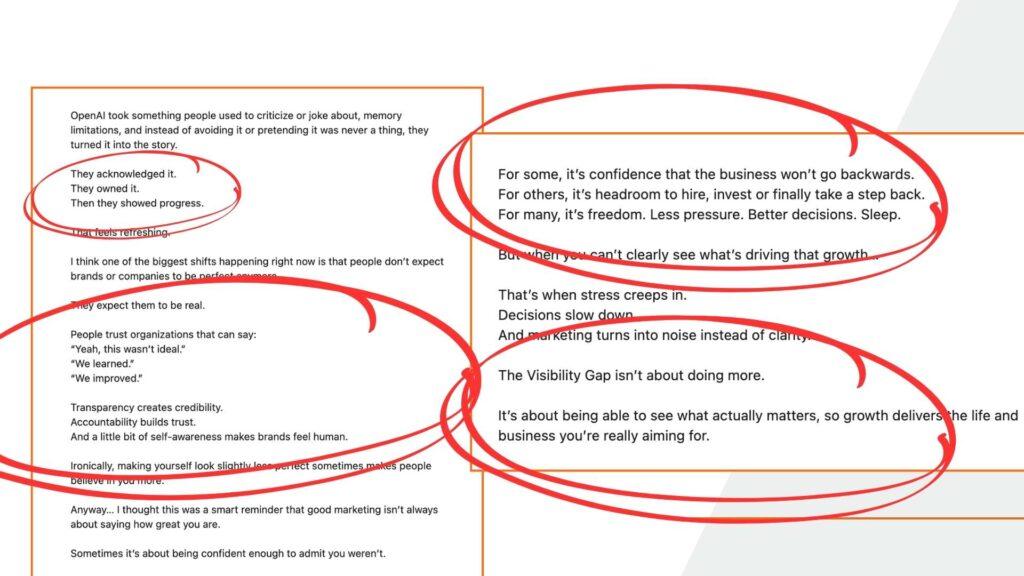
Individually, these structures aren’t bad.
The problem comes when people use them every day. They become noticeable and eventually, audiences recognise the formula.
The content becomes predictable, and predictable content rarely holds attention. It’s easy to forget or dismiss it.
The hidden problem with AI content
One of the biggest risks of using AI to write LinkedIn posts is that it can make us intellectually lazy.
Rather than sharing useful content, people are settling for average. Average content that doesn’t say anything or get any engagement.
The most valuable content on LinkedIn has always come from experience, expertise and perspective.
AI can help communicate those things, but it can’t replace them.
But it isn’t just making you lazy; it’s making you look lazy. It’s sending a message to users that you haven’t bothered to spend time creating something useful. It says you cut corners, and that is not a message you want to be projecting.
Why this matters more than ever
Social media usage remains incredibly high.
However, people are increasingly becoming consumers rather than creators.
Recent Ofcom research suggests that while social media usage remains widespread, fewer users are actively creating content, posting updates or participating in discussions.
The same research asked participants to identify fake social media profiles. 16- 24-year-olds were able to do so 88% of the time, but 25-34 and 35- 44-year-olds were less successful: 17% and 15%, respectively.
What’s happening on LinkedIn right now
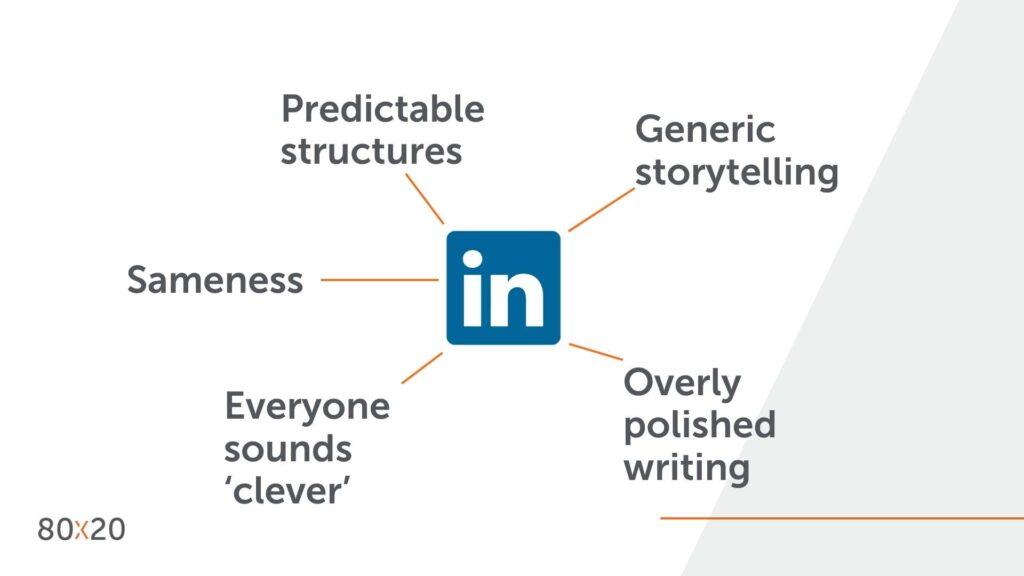
What we’re currently seeing on LinkedIn is an increase in AI-generated posts with:
- Predictable structures and robotic styles
- Generic storytelling
- Overly polished posts that are almost too perfect
- Everyone sounding clever
- Engagement suffering
Understanding dwell time and why sameness hurts brands
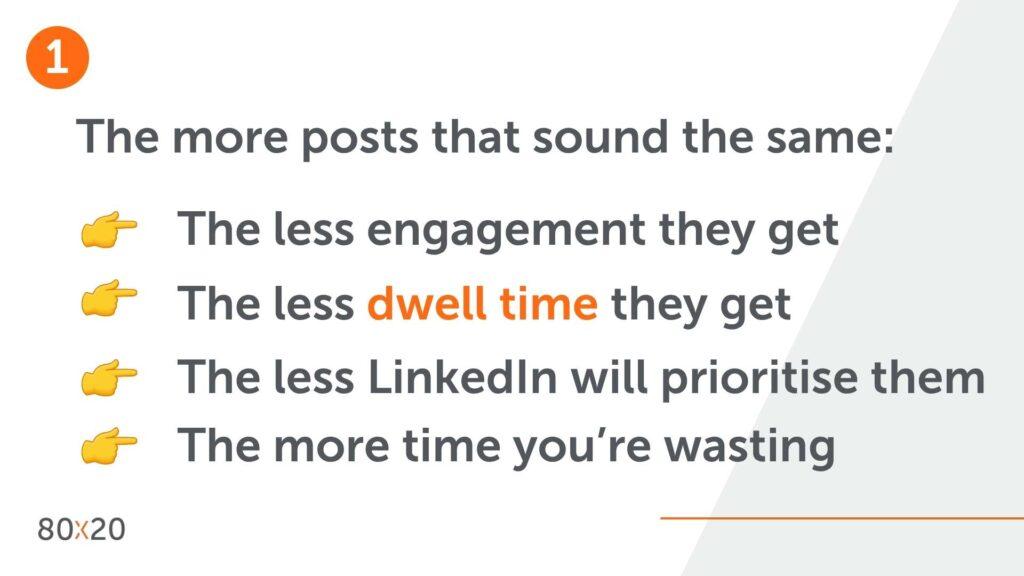
One of LinkedIn’s most important signals is dwell time, which measures how long somebody spends consuming your content.
The longer people spend reading, the stronger the signal that your content is valuable.
When posts all sound the same, readers make decisions faster. If they’ve seen the format before, and they know where it’s heading, they scroll past.
This creates a vicious circle:
- Lower engagement
- Reduced dwell time
- Reduced visibility
- Lower reach
- Less impact
Ironically, what feels like a time-saving shortcut often creates less effective content, and is damaging your brand.
Why human content is becoming more valuable
There is an interesting shift happening across search, social media and AI platforms.
The internet is becoming saturated with machine-generated content. As a result, human experience is becoming more valuable.
This is one reason why LinkedIn has become such an important platform.
A Semrush study found LinkedIn to be one of the most frequently cited domains across major AI platforms.
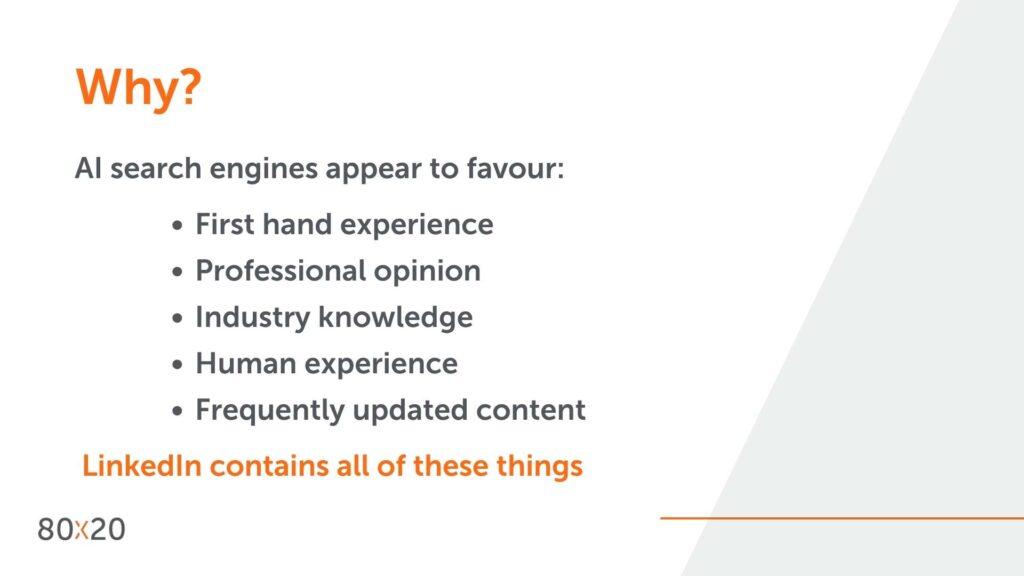
Why?
Because LinkedIn contains signals that AI systems value:
First-hand experience
Real stories, real challenges, real outcomes. Original thinking that AI can’t replicate.
Professional opinions
Industry perspectives and insights.
Subject matter expertise
Knowledge gained through experience rather than theory.
Human context
The nuances and lessons that only come from doing the work.
Fresh content
Regularly updated discussions and observations.
AI systems increasingly reward content that demonstrates genuine expertise and experience.
The irony is that the best way to benefit from AI is to be more human.
Why expertise still wins in professional services
If you’re an accountant, lawyer, HR consultant, recruiter, engineer or manufacturing specialist, people aren’t buying information.
They’re buying judgment, years of experience and the ability to solve real-world problems that Google, ChatGPT or a textbook can’t.
That’s exactly the type of content you should be sharing on LinkedIn.
Instead of explaining legislation that anyone can look up, explain:
- What businesses often misunderstand
- Mistakes you see clients making
- Lessons you’ve learned from projects
- Trends you’re seeing before others
- Opinions formed from years of experience
Those insights are difficult for AI to reproduce because they come from lived experience rather than publicly available information.
For example, compare these two LinkedIn posts.
Generic AI post
Here are five things businesses should know before hiring an accountant.
Useful but forgettable. Generic information that anybody could replicate.
Now compare it with:
Last week, a client almost signed a contract that would have cost them over £120,000 in avoidable tax over the next five years. Here’s the clause everyone missed…
Only an experienced accountant can write that.
The same principle applies across every professional service.
- A solicitor discussing a common contractual mistake.
- A recruiter explaining why excellent candidates reject job offers.
- An HR consultant sharing patterns they’ve noticed in employee grievances.
- A manufacturer describing how a customer solved a production bottleneck.
These stories don’t just educate your audience, but also demonstrate that you know what you’re talking about. They build trust.
AI should help you communicate those experiences more efficiently, but it shouldn’t replace the experiences themselves.
How to use AI for LinkedIn posts without sounding like AI
Start with your thinking
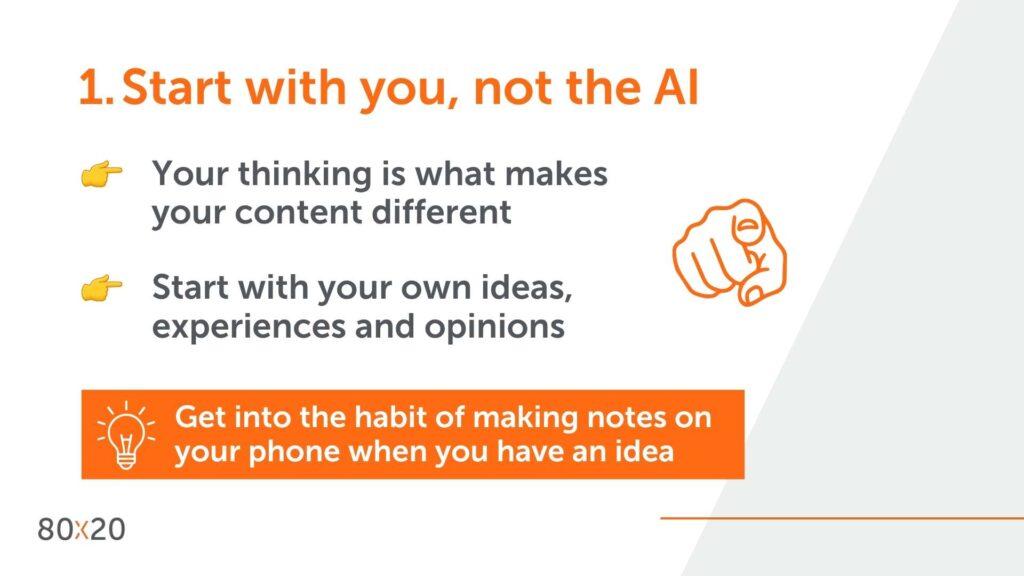
The strongest LinkedIn posts begin with an opinion.
Not a prompt or a trend, an opinion.
Begin by asking yourself:
- What do I believe?
- What frustrates me about my industry?
- What do clients misunderstand?
- What mistakes do I see repeatedly?
- What have I changed my mind about?
These are often the foundations of compelling content.
Tip: A useful habit to begin is keeping notes on your phone. Whenever an idea appears, capture it immediately.
Those thoughts become the raw material AI can help you shape later.
Use voice notes instead of blank prompts
Most professionals speak more naturally than they write.
Instead of typing a topic into ChatGPT, record a two-minute voice note.
Talk through:
- The situation
- Your opinion
- Your experience
- The lesson learned
Then ask AI to organise the transcript. The source material remains yours, but AI helps you to structure it.
Train AI to understand you
Most people start every AI conversation from scratch. That’s a mistake.
A better approach is to provide it with context about you or your business.
Share information about:
- Your audience
- Your expertise
- Your values
- Your services
- Your tone of voice
- Your goals
Example Prompt:
“Here is information about me, my business and my audience. Analyse it and use it as context for future LinkedIn content. Ensure all content reflects my expertise, values and communication style.”
The better the context, the better the output.
Feed AI your existing content

One of the easiest ways to improve AI-generated content is to provide examples of your own writing.
Upload a selection of posts that you have written, ideally posts that performed well.
Example Prompt:
“Analyse the following LinkedIn posts and identify my tone, style, vocabulary, sentence structure and recurring themes. Use these observations when creating future content.”
This creates a much stronger foundation than generic prompting.
Show AI what good and bad looks like
One of the most overlooked techniques is showing AI what you don’t like.
Many people tell AI what they want; few tell it what they dislike. Telling AI tools what not to do can be effective in improving the quality of the output.
For example, you might tell the tools to avoid:
- Posts that use motivational clichés.
- Overuse of em dashes.
- Generic storytelling.
- Empty inspiration.
- LinkedIn influencer language.
Example Prompt:
“Here are five LinkedIn posts I admire and five I dislike. Explain the differences. When writing for me, emulate the first group and avoid the second.”
Use AI to challenge your thinking
Most people use AI as an assistant; few use it as a critic.
This is a major missed opportunity.
Instead of asking AI to write a post, write the post yourself and ask:
- What am I missing?
- What’s weak about this argument?
- What would someone disagree with?
- What assumptions am I making?
Prompt:
“Challenge this opinion. Identify weaknesses, counterarguments and missing evidence. Help me strengthen the position before publishing.”
The result is often more thoughtful content.
Use AI as an editor, not a ghostwriter
Some of the best AI use cases happen after the content is written.
For example:
- Improve clarity.
- Reduce repetition.
- Simplify language.
- Improve readability.
- Strengthen the opening.
Prompt:
“Improve clarity and readability while preserving my personality, opinions and writing style. Do not make the content sound more corporate or polished.”
This keeps your voice intact.
Create a first draft, not a final post
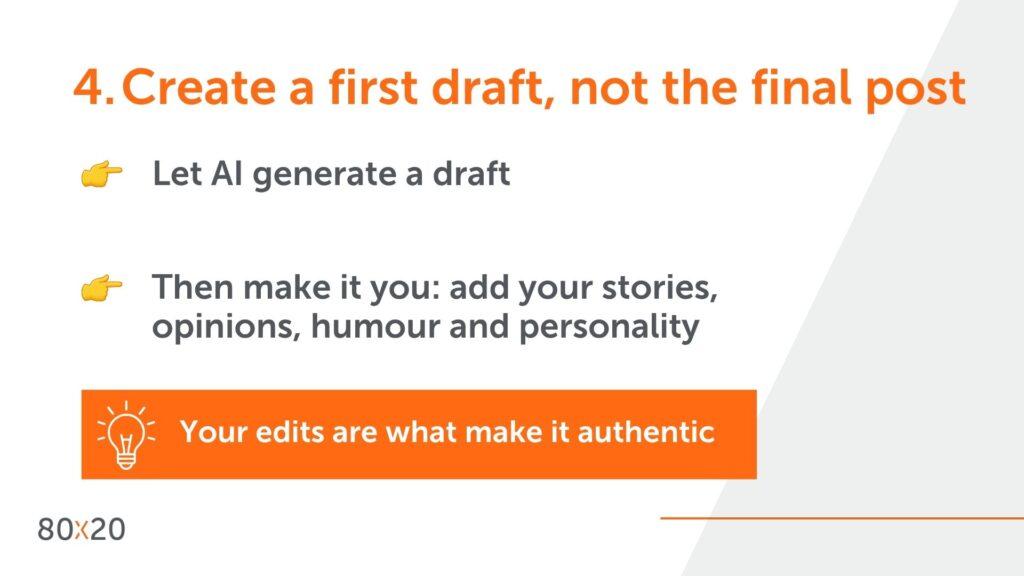
This is perhaps the most important principle. Use AI to create the starting point, not the finished product.
Once AI has created the first draft, add some of the following before publishing: :
- Stories
- Opinions
- Humour
- Experiences
- Lessons learned
- Customer examples or case studies
- Industry observations
- Results or outcomes
These are the elements that make content memorable.
They are also the parts AI cannot genuinely replicate.
Repurpose great ideas instead of creating more content
One great idea can become multiple pieces of content. AI is a useful tool for helping you to repurpose one piece of content into multiple formats.
A webinar can become:
- LinkedIn posts
- Blogs
- Email newsletters
- Videos
- Carousels
- Sales content
- Podcast discussions
Use AI to maximise valuable ideas rather than mass-produce mediocre ones.
Build a personal AI content assistant
The most advanced users create what we call a “brand brain.”
This is a document containing:
- Positioning
- Audience insights
- Core beliefs
- Stories
- Case studies
- Common objections
- Writing style
- Favourite content formats
- Topics to avoid
Over time, AI becomes increasingly aligned with your thinking, which results in more consistent, authentic content.
AI amplifies clarity. It doesn’t create it.
Many professionals believe AI is the solution; in reality, it is an amplifier.
If you don’t know:
- What you stand for
- What makes you different
- Who you serve
- What opinions you hold
- What you want to become known for
AI cannot solve those problems. It simply produces faster average content.
The professionals seeing the greatest results from AI have already done the foundational work.
They understand their audience. They have a point of view. They know what they want to be known for.
AI simply helps them communicate it more efficiently.
Additional prompts to help you create useful LinkedIn posts with AI
Below is a list of additional prompts that can help you to create useful LinkedIn posts with AI:
1. Build your AI foundation
Prompt
Here is information about me, my business and my audience. Analyse this information and remember it for the rest of this conversation. Write all future LinkedIn posts for business owners and marketing managers in my tone of voice, reflecting my expertise, values and positioning.
2. Learn my writing style
Prompt
Analyse these LinkedIn posts I’ve previously written. Identify my tone of voice, vocabulary, sentence structure, pacing, humour, use of storytelling and recurring themes. Use these observations when writing future posts.
3. Learn what I DON’T like
Prompt
Here are examples of LinkedIn posts I dislike. Explain why they feel generic or AI-generated. Never use these writing patterns when writing for me.
4. Compare good vs bad content
Prompt
Compare these LinkedIn posts.
Explain why the first examples are engaging and why the second examples aren’t.
Create a writing guide based on your findings.
5. Turn voice notes into posts
Prompt
Turn this voice note transcript into a LinkedIn post.
Keep my personality, opinions and conversational style.
Remove repetition but don’t over-polish the writing.
Highlight areas where I could add personal stories or examples.
6. Interview me
Prompt
Act as an experienced journalist.
Ask me one question at a time about this topic.
Keep asking follow-up questions until you’ve uncovered useful opinions, stories and lessons.
Once we’ve finished, write a LinkedIn post based on the conversation.
7. Find my unique angle
Prompt
Search your knowledge of this topic.
What is everyone else saying?
What isn’t being discussed?
Help me take a more original position.
8. Challenge my thinking
Prompt
Here’s my opinion.
Challenge it.
What assumptions am I making?
What would someone intelligent disagree with?
How could I strengthen my argument?
9. Spot weak arguments
Prompt
Read this LinkedIn post critically.
Identify weak logic, unsupported claims and vague statements.
Suggest ways to make the argument stronger.
10. Make it me human
Prompt
Review this LinkedIn post.
Highlight every sentence that sounds AI-generated.
Explain why.
Suggest more natural alternatives while preserving my personality.
11. Remove AI writing habits
Prompt
Rewrite this post but avoid:
- em dashes
- motivational clichés
- generic storytelling
- “It’s not X, it’s Y”
- predictable hooks
- corporate jargon
- overly polished language
Write naturally as if speaking to another business owner.
12. Improve readability
Prompt
Improve the readability of this LinkedIn post.
Shorten long sentences.
Remove unnecessary words.
Increase curiosity.
Keep my original opinions and tone.
13. Improve The Hook
Prompt
Suggest ten stronger opening hooks for this LinkedIn post.
Avoid clickbait.
Focus on curiosity, relevance or surprising insight.
14. Increase dwell time
Prompt
Read this like a busy LinkedIn user.
Tell me where you’d stop reading.
Explain why.
Suggest improvements that encourage people to continue reading.
15. Add stories
Prompt
Review this LinkedIn post.
Identify places where a personal story, customer example or lesson learned would make the post stronger.
16. Repurpose one idea
Prompt
Turn this LinkedIn post into:
- a carousel
- a blog outline
- an email newsletter
- a video script
- a podcast discussion
- five follow-up LinkedIn posts
17. Generate better content ideas
Prompt
Based on my audience, expertise and previous content, suggest 30 LinkedIn post ideas that demonstrate expertise rather than simply provide generic advice.
18. Find blind spots
Prompt
Based on everything you know about my audience, what important questions aren’t I answering in my LinkedIn content?
19. Create a contrarian view
Prompt
Here’s a common opinion within my industry.
Suggest three thoughtful ways I could challenge it without being controversial for the sake of it.
20. Final editorial review
Prompt
Before publishing this LinkedIn post:
- Remove unnecessary words.
- Check for AI writing patterns.
- Ensure my opinion is clear.
- Improve readability.
- Preserve my personality.
- Suggest one stronger ending.
- Give the post a score out of 10 and explain how to make it a 10.
Bonus prompt: Build your personal AI writing assistant
This is probably the most valuable prompt of all because it creates a long-term foundation rather than improving one post.
You are my LinkedIn writing assistant.
I want to become known for [your expertise].
My audience is [describe audience].
My tone is [describe tone].
My values are [list values].
Here’s my website, previous LinkedIn posts, case studies, speaking notes and articles.
Analyse everything and build a profile of my writing style, opinions, vocabulary and positioning.
Challenge weak ideas, suggest better ones and always preserve my voice.
Never write generic LinkedIn content. If a post sounds like something anyone could publish, tell me why and help me make it more distinctive.
Bonus prompt: Support your thinking
Because AI should support thinking, not replace it, include this as the final prompt:
I’m writing a LinkedIn post on TOPIC. I need help creating a post that adds value and sounds human.
Don’t write anything yet.
Instead, ask me questions until you fully understand what I think about this topic.
Challenge my assumptions, uncover stories from my experience and help me develop a stronger point of view.
Only once we’ve explored the topic thoroughly should you draft a LinkedIn post.
Final thoughts: The future of LinkedIn content is more human, not less
AI isn’t going away, and nor should it. Used correctly, it can help professionals create better content faster than ever before.
But there is a significant difference between using AI as a thinking partner and using it as a replacement for thinking.
The professionals who stand out on LinkedIn won’t be those who publish the most content.
They’ll be the ones who share genuine expertise, meaningful opinions and real-world experience.
So before asking AI what to post next, ask yourself, “What do you actually believe?”
That’s where great LinkedIn content starts.